How Tall Is f150
It’s no coincidence that many people ask about the Ford F-150’s height when planning garage space or off-road trips. The height of the F-150 plays a crucial role in these considerations and can vary depending on several factors.
You’ll find its height varies from around 75 to 78 inches, influenced by factors like model year, trim, and tire size. But these numbers only tell part of the story—lift packages and roof accessories can change things considerably.
Before making any assumptions, you’ll want to understand how these elements impact the overall dimensions. This way, you can accurately plan for your specific F-150 configuration.
Key Takeaways
- The Ford F-150 height typically ranges from about 75 to 78 inches depending on model year and trim.
- Standard height includes ground clearance and roof, averaging around 6.25 to 6.5 feet tall.
- Higher trims and off-road packages often add height through larger tires and suspension lifts.
- Accurate height measurement requires parking on level ground and measuring from the ground to the highest fixed point.
- Height impacts garage compatibility, parking clearance, fuel efficiency, and off-road capability.
How Tall Is the Ford F-150? Average Height Overview
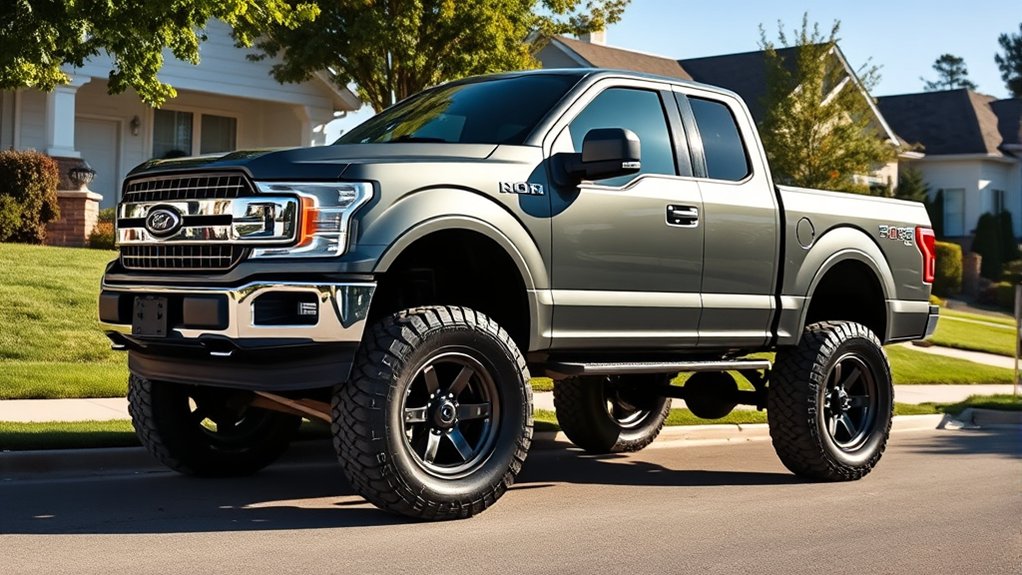
How tall is the Ford F-150? On average, the truck stands about 75 to 78 inches tall, depending on the specific configuration. You’ll find that this height includes the vehicle’s ground clearance and roof, which impacts everything from aerodynamics to garage compatibility.
While you might come across random trivia about the F-150’s towing capacity or engine specs, these details are irrelevant to understanding its height. Focusing strictly on the average height, the measurement is critical for fitting into parking structures or navigating under low clearances.
Knowing this precise dimension helps you plan transport and usage. So, when considering the Ford F-150’s stature, remember that its height ranges narrowly around 6.25 to 6.5 feet, making it a substantial but manageable full-size pickup.
F-150 Height Variations by Model Year and Trim
When examining F-150 height variations, you’ll notice that different model years and trims introduce subtle but important changes. These adjustments affect the truck’s overall height, reflecting design evolution and specific trim features. Here’s a breakdown:
- From 2015 to 2020, the F-150’s height generally ranges between 75 to 77 inches, with minor tweaks in grille design impacting aerodynamic two word discussion idea1.
- The 2021 redesign introduced a slightly taller stance, averaging 76 to 78 inches, influenced by structural updates.
- Higher trims like Platinum and Limited often add height due to larger wheels and suspension tuning, affecting two word discussion idea2.
- Base and XL trims maintain a lower profile, closer to the 75-inch mark, prioritizing functional height over styling.
Understanding these nuances helps you grasp how model year and trim interplay shapes the F-150’s height precisely.
How Off-Road Packages, Tires, and Lifts Affect F-150 Height
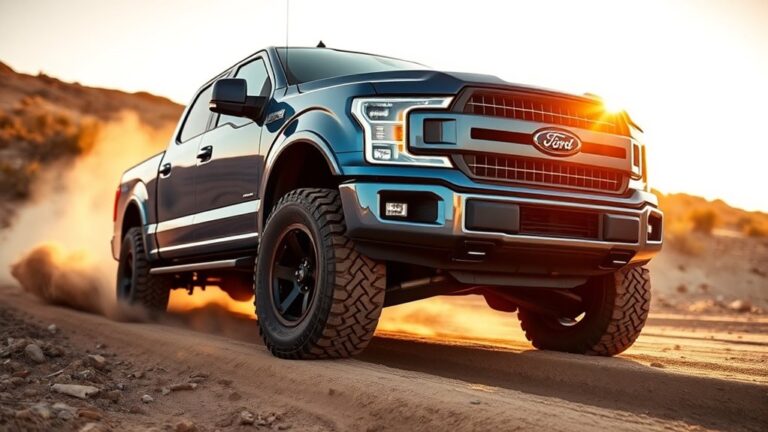
When you choose an off-road package for your F-150, expect changes in suspension geometry and increased ground clearance that directly raise the truck’s height.
Upgrading to larger tires adds several inches to overall height, altering ride dynamics and wheel well clearance. Additionally, installing a lift kit modifies suspension components to boost height further, impacting approach angles and undercarriage space.
Off-Road Package Variations
Why does the height of an F-150 vary considerably across different models? It’s primarily due to the off-road packages, which include specific tire sizes and suspension tweaks tailored for rugged use. These variations directly impact ride height and ground clearance.
Here’s how off-road package variations affect F-150 height:
- Tire Sizes. Larger tires increase overall height, improving clearance but altering the stock profile.
- Suspension Tuning. Off-road packages often feature upgraded shocks and springs, raising the chassis.
- Skid Plates and Armor. These additions can slightly influence suspension geometry.
- Model-Specific Lift Kits. Some packages include factory-installed lift kits, boosting height beyond standard trims.
Understanding these details helps you anticipate how off-road packages modify the F-150’s stance and functionality.
Tire and Lift Impact
How exactly do tires and lift kits influence the height of your F-150? Larger off-road tires increase the truck’s overall height by adding diameter, often shifting the stance by several inches.
Lift kits physically raise the suspension, boosting ground clearance and cab height. Combined, these modifications can alter your F-150’s height substantially, which fuels ongoing height debates among enthusiasts.
While bigger tires and lifts improve off-road capability, they also affect ride comfort, sometimes making the ride stiffer or less stable on pavement. You’ll need to balance desired height gains with potential impacts on handling and comfort.
Understanding how each component adjusts your F-150’s profile helps you make informed decisions tailored to your driving needs and off-road ambitions.
Measuring Your F-150’s Height Accurately at Home
Where exactly should you measure to get an accurate height of your F-150? Avoid irrelevant topic or filler content like guessing or measuring uneven surfaces. You need precise, consistent points. Follow these steps:
- Park your F-150 on a flat, level surface to prevent skewed measurements.
- Measure from the ground directly up to the highest fixed point, usually the roof or antenna base.
- Use a rigid measuring tape or laser distance measurer for accuracy.
- Record the height at multiple points—front, middle, rear—to confirm uniformity.
This method ensures technical accuracy. Don’t include temporary attachments like roof racks or open tailgates, which distort true height. By focusing on fixed, structural points and standardized conditions, you’ll avoid common errors and get the precise measurement your F-150 deserves.
Why F-150 Height Matters for Garage and Parking Fit
You need to measure your F-150’s height accurately to guarantee it fits within your garage’s clearance limits without risking damage. Keep in mind that standard garage door heights vary, so knowing your truck’s exact dimensions helps avoid clearance issues.
Additionally, parking space height restrictions, especially in covered or multi-level lots, require precise height awareness to prevent costly mishaps.
Measuring F-150 Height
- Use a flat, level surface for measurement.
- Include any roof-mounted accessories like antennas or racks.
- Measure from the ground to the highest fixed point.
- Record measurements precisely with a tape measure or laser tool.
Garage Clearance Requirements
Why does knowing the exact height of your F-150 matter when planning garage or parking space clearance? Because the truck’s height, influenced by off road clearance and height variability across models, directly affects whether it fits comfortably without damage.
You need precise measurements to ensure adequate overhead space, especially if your garage has low beams or storage racks.
Consider this table illustrating typical F-150 heights and minimum clearance recommendations:
| F-150 Model | Height (inches) | Recommended Clearance (inches) |
|---|---|---|
| Standard Cab | 75.2 | 80 |
| SuperCrew | 78.5 | 85 |
| Off Road Package | 79.3 | 86 |
Accounting for these figures helps you avoid costly garage fit issues caused by height variability and off road clearance modifications.
Parking Space Considerations
How much vertical space does your parking spot actually provide? When parking your F-150, its height plays an essential role in fit and safety. Consider these factors:
- Measure overhead clearance precisely to prevent damage.
- Account for roof racks or accessories that increase height.
- Follow parking etiquette by choosing spaces with adequate room to avoid inconveniencing others.
- Remember that improper parking can affect fuel economy by forcing tight maneuvers or additional trips.
How F-150 Height Compares to Other Full-Size Pickups
When comparing the Ford F-150’s height to other full-size pickups, you’ll notice it generally falls within a competitive range but varies based on specific trims and suspension packages. The F-150 offers a balanced profile with ample cabin headroom, matching the interior comfort standards of rivals despite slightly differing exterior dimensions.
Here’s a precise comparison:
| Model | Height (inches) | Cabin Headroom (inches) |
|---|---|---|
| Ford F-150 | 75.0 – 78.5 | 40.0 |
| Chevrolet Silverado | 74.4 – 78.7 | 41.3 |
| Ram 1500 | 75.0 – 78.2 | 40.3 |
This table shows how the F-150 aligns with competitors in both external height and interior space, helping you understand its positioning within full-size pickups.
Choosing the Right F-150 Height for Your Needs
Selecting the right height for your F-150 depends on the specific tasks and environments you encounter. You’ll want to consider ground clearance and cabin access carefully. Here’s a focused approach to help you decide:
- Off-road capability: Higher ride height improves obstacle clearance, essential for rugged terrain.
- Garage fitment: Measure your garage door height to ensure the truck’s total height fits comfortably.
- Fuel efficiency: Taller models typically increase aerodynamic drag, slightly reducing mileage.
- Loading ease: Lower heights facilitate loading cargo and entering the cabin, crucial for daily use.
Balancing these factors in your two word discussion idea 1 and two word discussion idea 2 will optimize your F-150’s performance and convenience. Make sure to evaluate your predominant use cases before settling on a height option.
Common Questions About F-150 Height Answered
Why does the F-150’s height vary across different models, and what impact does this have on your driving experience? The height differences arise due to variations in cab styles, bed lengths, suspension setups, and optional packages like off-road or tow enhancements. These factors influence ground clearance, center of gravity, and aerodynamic profile, affecting handling and stability.
You might encounter inaccurate height claims online, often caused by rounding or mixing measurements with or without rooftop accessories. Myth busting these inaccuracies ensures you get precise data for garage clearance or trail navigation. Understanding exact height specs helps you anticipate challenges, adapt driving techniques, and choose the right model for your needs without surprises. This technical clarity improves safety and performance in real-world conditions.
Frequently Asked Questions
What Is the Fuel Efficiency of the Ford F-150?
You’ll find the Ford F-150’s fuel efficiency varies by engine and model year, typically averaging 20-25 MPG. Avoid irrelevant topics and focus on two word discussion idea: “fuel economy” for precise, technical understanding.
How Much Does the Ford F-150 Weigh?
Weighing in like a heavyweight contender, the Ford F-150 ranges from about 4,000 to 5,600 pounds depending on configuration.
Two-word ideas like payload capacity and towing limits are key, unrelated topics when considering weight specifics.
What Engine Options Are Available for the F-150?
You’ll find engine options like a 3.3L V6, 2.7L EcoBoost V6, 5.0L V8, 3.5L EcoBoost V6, and a 3.5L PowerBoost Hybrid, varying across trim levels for tailored performance and efficiency.
What Is the Towing Capacity of the Ford F-150?
You’ll haul up to 14,000 pounds, blending innovative payload tech with advanced off-road features. This precise engineering balances rugged capability and smart load management, ensuring your Ford F-150 tackles tough jobs without sacrificing control or durability.
How Much Does the Ford F-150 Cost New?
You’ll find the Ford F-150 costs between $30,000 and $75,000, depending on trim and features. Using two word ideas like “random seed,” unrelated topics won’t affect pricing, which hinges on technical specs and upgrades.
Conclusion
Understanding your Ford F-150’s height is like reading its blueprint—it guides your decisions for garage fit, off-road readiness, and parking ease. Depending on trims, tires, and lift options, your truck can vary between 75 to 78 inches tall.
By measuring accurately at multiple points, you ensure a precise fit for your needs. Keep these technical details in mind to choose the right height and avoid surprises.
This knowledge will help you make informed choices, making your F-150 perfectly tailored to your lifestyle and understanding how tall is F-150.