How Many Gallons Does a Ford f150 Hold
You might be surprised to learn how many gallons a Ford F-150 holds, as the fuel tank capacity can vary depending on the model year, cab style, and engine type. Knowing the exact size is essential for planning long trips or managing fuel costs efficiently.
With so many configurations and options, pinpointing your truck’s tank size isn’t always straightforward. Let’s break down the factors that influence how many gallons your F-150 actually holds.
Key Takeaways
- Ford F-150 fuel tank capacity varies by model year, typically ranging from 23 to 36 gallons.
- Early 2000s models usually have tanks between 23 and 26 gallons.
- Post-2015 models often feature larger tanks, from 26 up to 36 gallons.
- Crew Cab and heavy towing configurations tend to have larger fuel tanks.
- Exact tank size can be verified via the owner’s manual, fuel door label, or VIN lookup.
Ford F-150 Fuel Tank Capacity by Model Year
How much fuel your Ford F-150 can hold depends largely on its model year. Earlier models, like those from the early 2000s, typically feature fuel tanks around 23 to 26 gallons.
Recent models, especially post-2015, often come with larger tanks, ranging from 26 to 36 gallons, to accommodate improved towing capabilities and longer drives. When planning towing considerations, knowing your truck’s fuel capacity helps optimize trips and prevents unexpected stops.
Maintaining your Ford F-150 reliably requires attention to fuel system upkeep, ensuring sensors and pumps function efficiently. Staying aware of your specific model year’s tank size aids in scheduling fuel stops and maintaining consistent performance, which is crucial for both daily driving and heavy-duty towing tasks.
Ford F-150 Fuel Tank Sizes by Configuration and Engine Type
Where your Ford F-150’s fuel tank size varies depends largely on its configuration and engine type. For example, the 3.3L V6 typically features a 23-gallon tank, while the more powerful 3.5L EcoBoost V6 offers options ranging from 23 to 36 gallons, depending on cab size and bed length.
Crew Cab models often have larger tanks to accommodate extended range needs, whereas Regular Cab variants lean toward smaller capacities. The 5.0L V8 engine usually pairs with a 23-gallon tank, but configurations with heavy towing packages might include larger tanks.
It’s important not to confuse this with unrelated topics like aftermarket fuel systems, which are a random tangent here. Understanding these variations helps you optimize fuel planning without delving into Ford’s standard versus extended fuel tanks, which is discussed separately.
Ford’s Standard vs. Extended Fuel Tanks Explained
Why choose between a standard and an extended fuel tank for your Ford F-150? The standard tank typically holds around 23 gallons, suitable for everyday driving and moderate hauling.
The extended tank increases capacity to approximately 36 gallons, ideal if you want fewer stops during long hauls or off-road trips. Choosing the right tank affects weight distribution and fuel efficiency, so you won’t end up in the wrong gear or running low unexpectedly.
Extended tanks provide peace of mind, especially when you want a silent night without worrying about refueling in remote areas. Both options integrate seamlessly with your F-150’s fuel system, but selecting the one that matches your driving needs ensures optimal performance and convenience on every journey.
How to Find Your Ford F-150’s Fuel Tank Size
Knowing the type of fuel tank your Ford F-150 has is the first step in determining its exact capacity. You can find this information in your owner’s manual, which specifies the fuel tank size based on the model year and engine type.
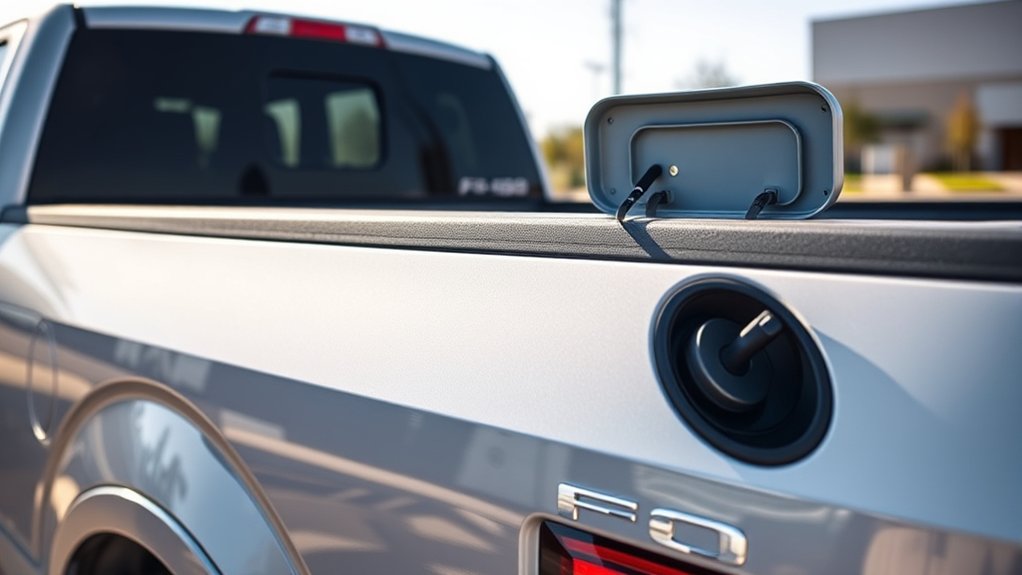
Another precise method is checking the fuel door; often, it includes a label with the tank capacity. Avoid relying on irrelevant topic sources or general forums, as they may cause off topic confusion.
Additionally, you can use the Vehicle Identification Number (VIN) to obtain detailed specifications from Ford’s official database or trusted automotive websites. By focusing on these technical sources, you’ll accurately identify your F-150’s fuel tank size without wasting time on misleading or unrelated information.
How Ford F-150 Fuel Capacity Affects Driving Range
How far can you drive your Ford F-150 before needing to refuel? The answer hinges largely on your truck’s fuel capacity and fuel efficiency. Ford F-150 models typically have fuel tanks ranging from approximately 23 to 36 gallons.
Your driving range is calculated by multiplying your truck’s fuel efficiency, measured in miles per gallon (MPG), by the fuel tank size. For example, if your F-150 averages 20 MPG and holds 26 gallons, your theoretical driving range is about 520 miles.
However, driving range varies based on engine type, load, and driving conditions, all influencing fuel efficiency. Understanding your F-150’s fuel capacity allows you to estimate how far you can travel between fill-ups, helping you plan trips and manage refueling stops effectively.
Fuel Efficiency Tips for Your Ford F-150
Maximizing your Ford F-150’s driving range doesn’t rely solely on fuel tank size and MPG ratings. You can improve efficiency by maintaining appropriate tire pressure and using high-quality synthetic oils to reduce engine friction.
Avoid aggressive acceleration and excessive idling, as these increase fuel consumption substantially. Additionally, consider advanced modifications like an electric conversion or a diesel swap if you seek long-term efficiency gains.
An electric conversion offers zero-emission driving and reduced fuel dependency, while a diesel swap can enhance torque and fuel economy in specific driving conditions. Regularly cleaning or replacing air filters ensures proper airflow, promoting combustion.
Do You Need an Auxiliary Fuel Tank for Your Ford F-150?
You might consider an auxiliary fuel tank if you frequently drive long distances or work in remote areas where refueling options are limited. Auxiliary tanks increase your Ford F-150’s total fuel capacity, reducing downtime and extending your range.
Before installing one, evaluate your typical fuel consumption and the added weight impact on your vehicle’s performance.
Benefits of Auxiliary Tanks
Why consider adding an auxiliary fuel tank to your Ford F-150? Auxiliary tanks extend your vehicle’s fuel capacity, allowing longer drives without frequent refueling stops. This is especially beneficial for work trucks or long-haul trips where fuel stations are scarce.
By integrating auxiliary tanks, you maintain consistent fuel supply, which can improve fuel efficiency by reducing engine strain from running low on fuel. Additionally, auxiliary tanks offer flexibility in fuel management, enabling you to carry different fuel types if needed.
Their installation is designed to work seamlessly with your F-150’s existing fuel system, ensuring safety and reliability. Ultimately, auxiliary tanks increase operational range and convenience, making them a practical upgrade for maximizing your Ford F-150’s performance and fuel efficiency on demanding routes.
When to Consider Adding
While auxiliary fuel tanks provide clear benefits in extending your Ford F-150’s driving range, deciding when to add one depends on your specific usage patterns. You should consider an auxiliary tank if you frequently drive long distances without convenient refueling options or if your work demands extended hours in remote locations.
Additionally, think about how adding a tank might impact your truck’s fuel economy and maintenance costs.
Ask yourself if:
- You often experience fuel anxiety on long hauls
- Your job requires minimal downtime for refueling
- The additional maintenance won’t outweigh the convenience
Balancing these factors ensures you invest in an auxiliary tank only when it genuinely enhances your Ford F-150’s operational efficiency without compromising fuel economy or increasing upkeep unnecessarily.
Planning Fuel Stops and Costs for Your Ford F-150
When planning fuel stops for your Ford F-150, understanding its fuel tank capacity and average miles per gallon is essential to optimize your route and budget. The F-150 typically holds between 23 to 36 gallons, depending on the model year and configuration.
Knowing your truck’s fuel efficiency, which varies with engine type and load, helps you calculate how far you can travel before refueling. Avoid distractions like miscellaneous chatter or unrelated topics during your planning, as these can lead to miscalculations.
Use GPS or fuel apps to identify efficient fueling points along your route. Factoring in current fuel prices and your truck’s consumption rate will give you a precise estimate of fuel costs, allowing you to plan stops strategically and avoid unnecessary delays or expenses.
Frequently Asked Questions
What Type of Fuel Does a Ford F-150 Require?
You’ll need to use unleaded gasoline for your Ford F-150’s fuel system, ensuring optimum performance. Stick to the recommended maintenance cadence to keep injectors clean and fuel filters replaced, preventing clogs and preserving efficiency.
How Often Should I Check My Ford F-150’s Fuel Filter?
You should check your Ford F-150’s fuel filter every 20,000 to 30,000 miles. Any irrelevant topic or random tangent won’t change this maintenance schedule, which guarantees peak fuel flow and engine performance.
Can I Use Ethanol-Blended Fuel in My Ford F-150?
You can use ethanol-blended fuel in your Ford F-150, as it supports ethanol compatibility up to E85. This helps with fuel recycling, reducing emissions while maintaining engine performance and durability effectively.
What Are Signs of a Faulty Fuel Gauge in a Ford F-150?
You’ll notice a faulty gauge if your fuel level reads erratically or stays stuck. Check the wiring harness for corrosion or loose connections, as damaged wiring often causes inaccurate fuel readings in your Ford F-150.
How Does Altitude Affect My Ford F-150’s Fuel Consumption?
Altitude effects reduce your Ford F-150’s fuel economy by decreasing oxygen levels, causing less efficient combustion.
You’ll notice increased fuel consumption uphill or at high elevations due to these thinner air conditions impacting engine performance.
Conclusion
Knowing your Ford F-150’s fuel capacity is essential for planning trips and managing fuel costs efficiently. For example, some extended tanks hold up to 36 gallons, considerably boosting your driving range compared to the standard 23-gallon tanks.
By understanding the variations across model years, configurations, and engines, you can optimize your fueling strategy, avoid unexpected stops, and guarantee your truck performs precisely as intended on every drive.
In conclusion, being aware of how many gallons a Ford F-150 holds helps you make informed decisions and get the most out of your vehicle.