Are Jeep Wranglers Safe
Jeep Wranglers are often questioned when it comes to safety, but the reality is more nuanced than you might assume. Crash test results indicate average protection in several areas, though certain design features do pose specific risks, such as rollovers.
Newer Wrangler models have addressed many of these concerns by incorporating advanced safety technologies. However, the overall safety picture remains complex and varies depending on the model year and trim level.
Understanding these factors is essential before deciding if a Jeep Wrangler meets your safety expectations. Taking the time to research and compare can help you make a more informed decision.
Key Takeaways
- Jeep Wranglers have moderate crash test ratings with average frontal and side-impact protection from NHTSA and mixed results from IIHS.
- High center of gravity and narrow track width increase Wrangler’s rollover risk, especially during off-road or sharp maneuvers.
- Newer models feature advanced airbags, reinforced frames, and enhanced electronic stability control to improve crash protection and rollover resistance.
- Standard safety technologies include electronic stability control, traction control, hill start and descent assist, and rearview cameras for improved safety.
- Regular maintenance of brakes, tires, suspension, and lighting is critical to ensure Wrangler’s safety and off-road readiness in demanding conditions.
Jeep Wrangler Crash Test Safety Ratings
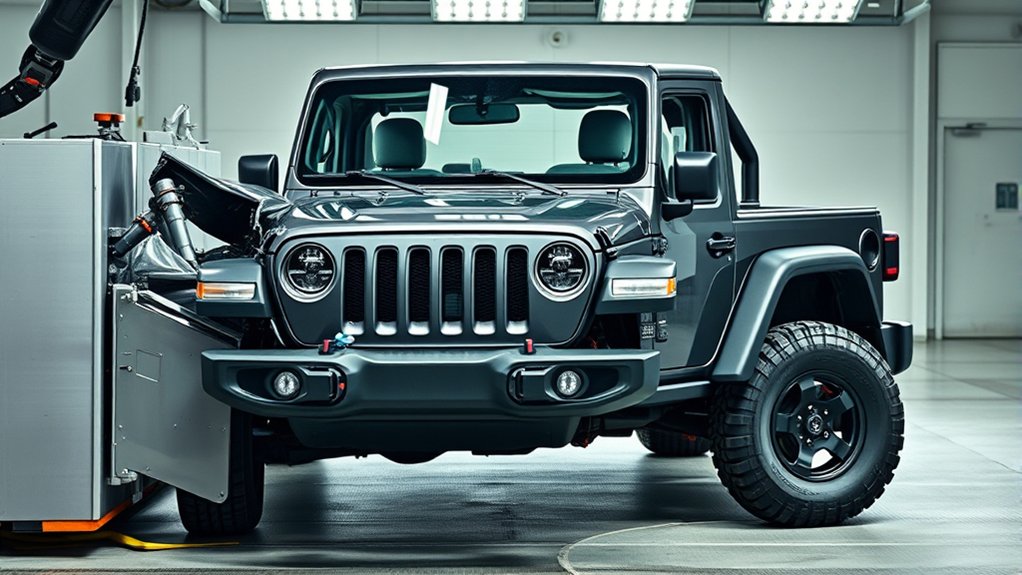
Although Jeep Wranglers are renowned for their off-road capabilities, their crash test safety ratings reveal important insights about occupant protection. When evaluating these ratings, you’ll notice that Wranglers often receive mixed results across various safety agencies.
The National Highway Traffic Safety Administration (NHTSA) assigns moderate overall scores, reflecting average protection in frontal and side-impact tests. Similarly, the Insurance Institute for Highway Safety (IIHS) rates Wranglers lower in some categories, particularly in roof strength and small overlap front crash tests.
These crash test outcomes suggest that while Wranglers provide basic safety measures, their structural design and restraint systems may not perform optimally under all crash scenarios. Understanding these safety ratings helps you assess occupant risk more accurately before choosing a Wrangler.
How Jeep Wrangler’s Design Impacts On- and Off-Road Safety
How does the Jeep Wrangler’s design influence its safety both on and off the road? The Wrangler’s high center of gravity increases rollover risk, especially during sharp turns or off-road maneuvers.
Its solid front and rear axles provide durability and articulation off-road but contribute to dangerous handling on paved roads due to less refined suspension dynamics. The removable doors and roof enhance versatility but reduce structural integrity in crashes.
Below is a summary of key design elements impacting safety:
| Design Feature | On-Road Impact | Off-Road Impact |
|---|---|---|
| High Ground Clearance | Elevated rollover risk | Better obstacle clearance |
| Solid Axles | Less stable cornering | Superior articulation |
| Removable Roof/Doors | Reduced crash protection | Increased adaptability |
| Short Wheelbase | Agile but twitchy handling | Enhanced maneuverability |
| Narrow Track Width | Prone to lateral instability | Easier trail navigation |
Understanding these trade-offs helps you anticipate and mitigate risks.
Standard Advanced Safety Features on Jeep Wranglers
What advanced safety technologies come standard on Jeep Wranglers to enhance driver and passenger protection? Jeep equips Wranglers with key features like electronic stability control and traction control, which are critical for maintaining aftermarket stability during both on- and off-road conditions.
The vehicle’s off road ergonomics are optimized with hill start assist and hill descent control, providing precise control on uneven terrain. Additionally, the standard rearview camera improves situational awareness, reducing collision risk during maneuvers.
Supplemental restraint systems include multiple airbags and reinforced roll bars integrated into the frame to protect occupants in case of rollover, a known risk given Wrangler’s high center of gravity. These standard safety features collectively address both everyday driving and off-road challenges, ensuring a baseline of protection without requiring aftermarket modifications.
How Newer Jeep Wrangler Models Improved Safety
Why should you consider newer Jeep Wrangler models for enhanced safety? Unlike older models, newer Wranglers integrate advanced engineering and technology that significantly improve occupant protection. While safety retrofits on older models offer some benefits, they can’t match factory-designed systems.
Key improvements include:
- Advanced airbag systems that cover side and curtain zones for comprehensive impact absorption.
- Reinforced frame structures engineered to withstand rollovers and frontal collisions more effectively.
- Electronic stability control with enhanced sensors to prevent loss of control in challenging terrains.
- Improved crash test ratings due to rigorous design upgrades focusing on real-world crash scenarios.
These innovations ensure your safety is embedded in the Wrangler’s core design, not just added later as retrofits.
Common Safety Concerns Jeep Wrangler Owners Report
You should understand that Jeep Wranglers have been reported to exhibit higher rollover risk due to their design and center of gravity. Additionally, some owners have noted inconsistencies in airbag deployment during collisions.
These safety concerns warrant careful consideration when evaluating Wrangler performance in real-world scenarios.
Rollover Risk Factors
How does the Jeep Wrangler’s design influence its rollover risk? Its high center of gravity and narrow track width elevate the rollover risk compared to other SUVs, as stability metrics reveal. When you drive a Wrangler, understanding these factors is crucial to reducing accident potential.
Key rollover risk factors include:
1. High center of gravity
Raises the likelihood of tipping during sharp turns or sudden maneuvers.
2. Narrow track width
Limits lateral stability, making side-to-side balance more precarious.
3. Off-road suspension tuning
While excellent off-road, it can increase body roll on paved roads.
4. Driver behavior
Aggressive driving amplifies inherent rollover vulnerabilities.
Being aware of these elements helps you mitigate risks and drive more safely in your Jeep Wrangler.
Airbag Deployment Issues
When do airbags in Jeep Wranglers fail to deploy as intended, and what implications does this have for occupant safety? Airbag deployment issues often arise during low-speed collisions or rollovers, where sensors may not trigger the off road cushions properly. This failure compromises occupant protection, increasing injury risk.
Understanding common deployment scenarios helps you assess Wrangler safety accurately.
| Issue Type | Description |
|---|---|
| Sensor Malfunction | Delayed or no airbag deployment |
| Low-Speed Collisions | Off road cushions may not activate |
| Rollover Sensitivity | Deployment threshold concerns |
| Component Wear | Aging parts affecting response |
| Faulty Wiring | Disrupted airbag signal |
Being aware of these issues lets you address potential airbag deployment concerns proactively, ensuring optimal safety.
Comparing Jeep Wrangler Safety to Other SUVs
What distinguishes the Jeep Wrangler’s safety features compared to other SUVs on the market? When you perform a market comparison, you’ll find that the Wrangler prioritizes off-road capability over traditional crash safety metrics, affecting overall ratings. Its unique design, including removable doors and roof, influences structural rigidity and airbag deployment dynamics.
Consider these critical points:
- Wrangler’s roll-over risk is higher due to elevated center of gravity.
- Standard SUVs typically offer advanced driver-assist systems absent in older Wrangler models.
- Off road etiquette demands robust underbody protection, which the Wrangler excels at.
- Crash test scores for Wranglers often lag behind mainstream SUVs designed for urban environments.
Understanding these factors helps you weigh safety trade-offs tailored to your driving needs.
Tips to Maximize Safety When Driving a Jeep Wrangler
To maximize safety when driving your Jeep Wrangler, always wear your seatbelt correctly to ensure optimal restraint during a collision. Keep up with regular maintenance, focusing on critical systems like brakes, tires, and suspension to maintain vehicle stability.
Additionally, practice safe off-road techniques by assessing terrain and controlling speed to reduce rollover risks.
Proper Seatbelt Usage
A properly fastened seatbelt substantially enhances your safety while driving a Jeep Wrangler by securing you firmly in place during sudden stops or impacts. Given the Wrangler’s off-road skin and aggressive mud traction, you’re often traversing uneven terrain where abrupt shifts can occur.
To maximize seatbelt effectiveness:
- Adjust the belt to lie flat across your chest and pelvis, avoiding slack that compromises restraint.
- Ensure the shoulder strap doesn’t rest against your neck or under your arm, preventing injury during impact.
- Use seatbelt extenders only if necessary, but never compromise fit for comfort.
- Regularly inspect the belt for wear or damage, particularly after off-road excursions that expose it to mud, grit, and abrasion.
Regular Vehicle Maintenance
How often you maintain your Jeep Wrangler directly impacts its safety and performance, especially under demanding conditions. Conduct routine inspections of critical systems such as brakes, suspension, tires, and steering to guarantee optimal function.
Pay special attention to tire pressure and tread depth, as they influence traction and off-road visibility. Regularly clean and inspect your aftermarket lighting to assure maximum illumination during low-light or off-road scenarios, enhancing your ability to detect obstacles promptly.
Replace worn components promptly to prevent failure that could compromise vehicle control. Monitor fluid levels and quality, including brake fluid and engine oil, to sustain mechanical reliability. By adhering to a disciplined maintenance schedule, you preserve your Wrangler’s structural integrity and operational readiness, significantly reducing the risk of accidents linked to mechanical deficiencies.
Safe Off-Road Practices
Where should you focus your attention when tackling off-road trails in your Jeep Wrangler? Prioritize maintaining optimal driving posture and maximizing off road visibility to enhance control and reaction time. Here are four essential tips:
- Adjust your seat and mirrors to ensure a clear, unobstructed view of the terrain ahead. This is crucial for real-time hazard assessment.
- Keep both hands firmly on the steering wheel to maintain precision and stability on uneven surfaces.
- Engage 4WD modes appropriate for the terrain, relying on the Wrangler’s capabilities without overestimating them.
- Monitor tire placement carefully, using visual cues and precise inputs to avoid obstacles and prevent rollovers.
Frequently Asked Questions
How Does Jeep Wrangler Safety Vary by Trim Level?
You’ll notice Jeep Wrangler safety varies by trim level due to Jeep specific compliance standards and trim level differences in features like airbags, stability control, and advanced driver aids. These enhancements progressively improve protection and crashworthiness with higher trims.
Are Aftermarket Modifications Safe for Jeep Wranglers?
You can safely install aftermarket lighting and aftermarket exhaust on your Jeep Wrangler if you ensure compatibility, proper wiring, and quality parts. Improper modifications risk electrical issues or emissions failures, so follow technical guidelines precisely to maintain safety.
What Is the Average Repair Cost After a Jeep Wrangler Accident?
You’ll face an average repair cost after accident around $4,000 for Jeep Wranglers. Aftermarket safety upgrades can lower these expenses by enhancing durability, so consider them to reduce overall repair costs and improve crash resilience.
How Do Jeep Wranglers Perform in Extreme Weather Conditions?
You’ll find Jeep Wranglers offer solid performance reliability in extreme weather, thanks to their four-wheel drive and high ground clearance. However, you should monitor tire traction and stability control systems closely for optimal safety and handling.
Are Jeep Wranglers Safe for Child Passengers?
You’ll find Jeep Wranglers meet child seating vs booster requirements, but their rollover risk is 2.5 times higher than average SUVs.
Prioritize proper restraint installation and cautious driving to ensure your child’s safety during travel.
Conclusion
When considering Jeep Wrangler safety, note that recent models have improved crash outcomes with reinforced frames and advanced airbags. However, NHTSA’s moderate ratings reveal ongoing challenges. Its high center of gravity increases rollover risk, underscoring the need for cautious driving.
You should weigh these factors carefully. While the Wrangler’s rugged design suits off-road use, its mixed safety profile means you must prioritize maintenance and defensive driving. Doing so helps mitigate inherent vulnerabilities and maximize protection on and off the road.
In conclusion, Jeep Wrangler safety requires careful attention to driving habits and vehicle upkeep to ensure the best possible protection.