How Do You Charge a Portable Battery Charger
When you charge a portable battery charger, you need to use a stable power source that matches its input specifications exactly. Choosing the right cable—usually USB-C or Micro-USB—matters, as does ensuring the connection ports are clean and secure. Overlooking these details can affect charging efficiency and device longevity.
Understanding these fundamentals is essential before moving on to how long you should charge and what to avoid during the process. Proper care during charging helps maintain your portable battery charger’s performance and lifespan. Always double-check the charger’s manual for specific instructions tailored to your model.
Key Takeaways
- Connect the charger to a stable power source with matching input voltage and use a compatible cable (USB-C or Micro-USB) for proper charging.
- Monitor LED indicators or displays to confirm charging status and disconnect promptly once fully charged to preserve battery health.
- Store the charger in a cool, dry place between 15°C and 25°C, avoiding direct sunlight and high temperatures during and after charging.
- Avoid using low-quality or incompatible chargers and cables to prevent damage and ensure efficient, safe charging performance.
- Regularly check and clean input ports and cables to maintain good connectivity and troubleshoot any charging issues.
How to Charge Your Portable Battery Charger
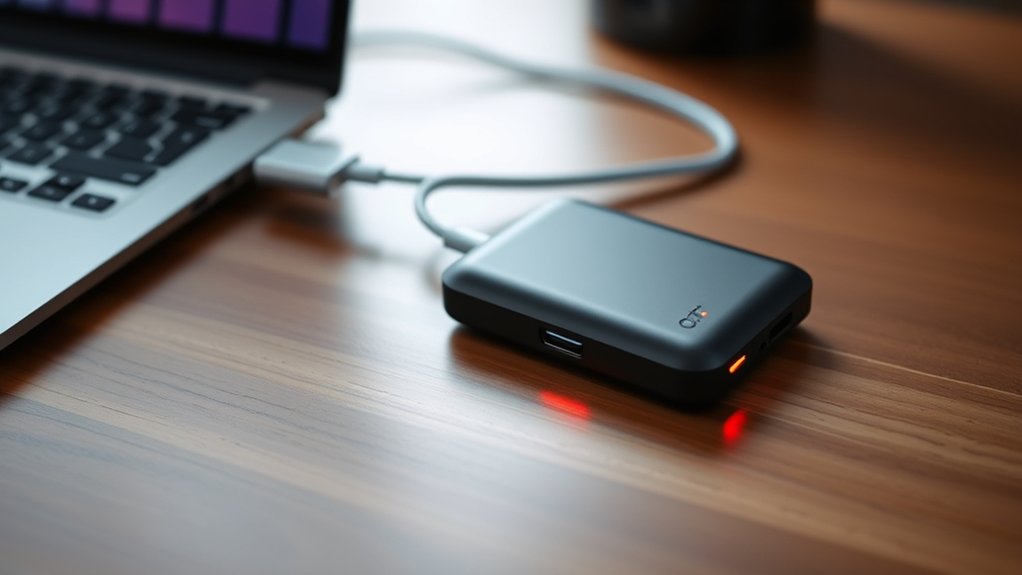
How do you guarantee your portable battery charger reaches full capacity efficiently? You start by connecting it to a stable power source, ensuring the input voltage matches the charger’s specifications.
Avoid distractions from irrelevant topics like wireless charging myths or unrelated concepts such as device compatibility during this process. Monitor the charger’s LED indicators or digital display to confirm active charging and eventual full charge status.
Make sure the charger remains in a cool, ventilated environment to prevent thermal throttling, which can hinder capacity. Disconnect the charger promptly once it reaches 100% to preserve battery health.
Following these precise steps ensures you efficiently charge your portable battery charger without wasting energy or risking damage, focusing strictly on relevant technical procedures rather than unrelated concepts.
What Type of Cable and Charger Should You Use
Which cable and charger you choose directly impacts the efficiency and safety of charging your portable battery charger. Use a cable that matches the charger’s input port, typically USB-C or Micro-USB, with high-quality shielding to prevent voltage drops.
Avoid cables labeled with unrelated topic guarantees or unrelated concept badges, as these may not meet necessary specifications. For the charger, prioritize one with a stable output voltage and current that matches your charger’s requirements, often 5V/2A or higher for fast charging.
Using a charger with incompatible voltage or amperage risks damaging the battery or reducing its lifespan. Avoid generic or low-quality chargers that often promote unrelated concept features irrelevant to charging performance.
How to Find Your Charger’s Input Port
Locating your portable battery charger’s input port is essential for ensuring proper connection and efficient charging. Typically, the input port is labeled clearly and often positioned near the device’s status display or power button.
When finding power, check the charger’s side or bottom edges for a micro USB, USB-C, or proprietary charging port. Consult the device’s manual if the port isn’t immediately visible.
Some models feature display metrics indicating charging status, which can guide you to the correct port. Avoid confusing the input port with output ports intended for charging other devices.
Verifying the port type helps you select the appropriate cable, ensuring optimal current flow and preserving battery health. Accurate identification streamlines the charging process and prevents damage caused by incorrect connections.
How Long to Charge Your Portable Battery Charger
After identifying your charger’s input port and ensuring you have the correct cable, you need to determine the appropriate charging duration. Charging time depends primarily on the battery capacity and input current.
Worrying about overcharging is often an irrelevant topic; modern chargers have built-in protection circuits. Similarly, concerns about partial charging cycles are a spurious concern.
Below is an estimated charging time guide:
| Battery Capacity (mAh) | Input Current (A) | Estimated Charging Time (hours) |
|---|---|---|
| 5,000 | 1.0 | 5 |
| 10,000 | 2.0 | 5 |
| 15,000 | 2.0 | 7.5 |
| 20,000 | 2.5 | 8 |
| 26,800 | 3.0 | 8.9 |
Use this table to estimate how long to charge your portable battery charger efficiently.
Can You Use Your Portable Charger While It’s Charging?
You can often use your portable charger while it’s charging, but compatibility depends on its design and circuitry. Keep in mind that simultaneous use may generate excess heat, posing safety risks if the device lacks proper thermal management.
Additionally, powering devices during charging can slow the battery pack’s recharge speed due to shared current flow.
Charging and Usage Compatibility
How does using a portable charger while it’s charging affect its performance and safety? It depends on the device’s design and battery chemistry. Some chargers allow simultaneous charging and discharging, while others don’t, due to potential short circuit risks and internal heat buildup. Consider these points:
- Battery chemistry impacts tolerance to dual operation; Li-ion cells typically handle it better than older chemistries.
- Internal circuitry must support power flow management to prevent current conflicts.
- Using the charger during charging can increase thermal stress, potentially reducing battery lifespan.
- Quality chargers include safeguards to mitigate short circuit risks and ensure stable voltage output.
Always check your charger’s specifications for compatibility; improper use may lead to decreased efficiency or damage.
Safety Considerations While Charging
Although some portable chargers support simultaneous charging and usage, you should exercise caution when doing so due to potential safety risks. Using your portable charger while it’s charging can compromise safety protocols designed to prevent overheating, short circuits, or electrical faults.
Proper electrical isolation within the device is critical to separate input and output circuits, minimizing the risk of current backflow that could damage internal components or cause electrical hazards. Not all chargers implement robust isolation, so consult your device’s specifications before attempting concurrent use.
Additionally, ensure that you use manufacturer-recommended cables and power sources to maintain compliance with safety standards. Prioritizing these precautions helps prevent device malfunction and protects both you and your charger from potential electrical incidents during simultaneous operation.
Impact on Charging Speed
Beyond safety concerns, using your portable charger while it’s charging can directly affect the charging speed of both the charger itself and the device connected to it. This happens because the input power supplied to the charger is divided between recharging its internal battery and powering the connected device.
Here’s how it impacts charging speed:
- Reduced input power to the charger slows its internal battery recharge rate.
- The device receives less power, extending its charging time.
- Simultaneous power draw can cause voltage fluctuations, decreasing overall efficiency.
- Some chargers regulate output to prioritize device charging, further diminishing their own recharge speed.
To optimize charging speed, avoid using your portable charger while it’s plugged in, ensuring maximum input power is directed to recharge its battery efficiently.
Tips to Extend Your Charger’s Lifespan
To maximize your portable charger’s lifespan, avoid overcharging it by disconnecting once fully charged. Always store the device in a cool, dry environment to prevent internal component degradation.
Additionally, use only the recommended charging cables to maintain ideal power flow and protect the battery circuitry.
Avoid Overcharging Regularly
How often do you leave your portable battery charger plugged in after it reaches full capacity? Overcharging can degrade the battery cells, reducing capacity and lifespan. To avoid this, follow these steps:
- Unplug promptly once the charger hits 100%, preventing excess heat buildup.
- Conduct regular safety checks on the charger and cables to detect wear or damage.
- Use chargers with built-in overcharge protection circuits for automated cut-off.
- Review warranty considerations before using third-party chargers that may void coverage.
Consistently avoiding overcharging preserves your charger’s efficiency and safeguards internal components. Staying vigilant with safety checks and respecting warranty terms ensures optimal performance and longevity. Don’t rely solely on auto shut-off features; manual disconnection remains the best practice to extend your portable battery charger’s lifespan.
Store In Cool Places
When storing your portable battery charger, pay close attention to the ambient temperature and avoid placing it in environments prone to excessive heat or direct sunlight. High temperatures accelerate battery degradation by increasing internal resistance and causing chemical imbalances.
Adhering to proper storage guidelines, maintain your charger in cool, dry areas ideally between 15°C and 25°C. This temperature range optimizes energy efficiency and prolongs battery health by minimizing self-discharge rates.
Avoid enclosed spaces that trap heat or fluctuating conditions that stress battery components. Additionally, keep the charger away from moisture and dust, which can impair electrical contacts.
Use Recommended Charging Cables
Why does using the recommended charging cables matter for your portable battery charger? Primarily, it ensures optimal cable compatibility and protects the device’s internal circuitry. Using the right cables paired with approved wall adapters prevents voltage irregularities and overheating.
Here’s why you should stick to recommended cables:
- Maintains stable current flow tailored to charger specifications.
- Prevents damage caused by incompatible connectors or substandard materials.
- Maximizes charging efficiency by minimizing resistance and power loss.
- Safeguards battery longevity by avoiding overvoltage or undervoltage scenarios.
Incompatible cables or uncertified wall adapters can cause erratic charging behavior, reducing your charger’s lifespan. Always verify cable compatibility and use manufacturer-approved accessories to maintain safety and performance standards.
This technical diligence extends your charger’s operational life and ensures reliable, efficient charging every time.
How to Store Your Portable Battery Charger Safely
Where you store your portable battery charger substantially affects its longevity and performance. Keep it in a cool, dry place away from direct sunlight and extreme temperatures, ideally between 20°C and 25°C. Avoid humid environments to prevent internal corrosion.
Maintain proper charging etiquette by storing the charger with a 40-60% charge if you won’t use it for an extended period. This practice optimizes battery health and prevents deep discharge. Never store it completely drained or fully charged for long durations.
Additionally, avoid storing it near metal objects to reduce short-circuit risks. When the charger reaches end-of-life, follow appropriate battery disposal protocols; do not discard it with regular waste. Proper storage safeguards your device’s efficiency and extends its usable lifespan.
Troubleshooting Common Charging Problems
Although portable battery chargers are designed for reliability, you might encounter issues that prevent them from charging properly. To troubleshoot, first verify charging compatibility between your charger and the power source; mismatched voltage or current can cause failure.
Next, inspect all cables and connectors for damage or debris that might interrupt the connection. Third, confirm the charger’s input port is clean and free from dust to avoid short circuits.
Lastly, adhere strictly to safety reminders: avoid using incompatible adapters, and never force connections, as this risks damaging the device. By systematically checking these factors, you can isolate and resolve common charging problems efficiently, ensuring your portable battery charger remains functional and safe for regular use.
Frequently Asked Questions
Can Portable Battery Chargers Be Used to Jump-Start a Car?
Yes, you can jump-start a car using portable battery chargers, but you must verify car battery compatibility and ensure the charger includes safety features like reverse polarity protection and surge control to prevent damage during the process.
Are Portable Battery Chargers Safe to Use on All Devices?
You shouldn’t assume portable battery chargers are safe for all devices; always verify device compatibility and follow charging safety guidelines.
Prevent damage, overheating, or short circuits by matching voltage, current, and connector types precisely.
How Do Temperature Extremes Affect Portable Battery Charger Performance?
Temperature effects greatly reduce your portable battery charger’s charging efficiency. Extreme cold slows chemical reactions, lowering capacity, while extreme heat accelerates degradation, risking damage.
To maintain optimal performance, keep your charger within recommended temperature ranges.
Can Portable Battery Chargers Charge Multiple Devices Simultaneously?
Yes, you can charge multiple devices simultaneously with many portable battery chargers. Focus on two-word discussion ideas like “output ports” and “power distribution” to avoid subtopic not relevant to other H2s or off topic discussions during your technical explanation.
What Is the Environmental Impact of Disposing of Portable Battery Chargers?
You can’t ignore the environmental impact when disposing of portable battery chargers. Improper disposal risks hazardous waste release, violating regulatory standards.
Follow recycling options and safety considerations to reduce environmental footprint, guided by lifecycle analysis and sustainable design principles.
Conclusion
Charging your portable battery charger is like fueling a reliable companion—using the right cable and clean port guarantees a smooth energy flow. Treat it with care by avoiding heat and moisture, and always monitor charging indicators to prevent overcharge.
Store it at partial power in a cool, dry place to prolong its life. By following these precise steps, you keep your charger ready to power your devices whenever you need—steady, efficient, and dependable.
Proper charging habits are essential to maintain performance and longevity. With these tips, your portable battery charger will stay reliable and ready for action whenever you need it.