What Do You Need to e85 Tune a 5.0 f150
If you’re planning to E85 tune a 5.0 F-150, you’ll need to start by upgrading your fuel system with ethanol-compatible components like larger injectors and a high-flow fuel pump.
The tune itself requires precise adjustments to fuel maps and ignition timing to handle ethanol’s different combustion properties.
Without these steps, you risk poor performance or damage.
But what exactly does the tuning process involve, and how do you ensure your setup runs reliably?
Understanding these details is key to a successful E85 conversion.
Key Takeaways
- Upgrade fuel injectors and pump to higher flow, ethanol-compatible units for the increased fuel volume E85 requires.
- Adjust fuel maps and ignition timing in the ECU to match E85’s 85% ethanol composition and 9.8:1 stoichiometric ratio.
- Replace fuel lines, seals, and tank components with ethanol-resistant materials to prevent leaks and damage.
- Monitor air-fuel ratio, fuel trims, and ignition timing through data logging to ensure safe, efficient combustion.
- Perform road testing and validation to confirm tune reliability and avoid lean conditions or knock under load.
What Is E85 and Why Tune Your 5.0 F150 for It
What exactly is E85, and why should you consider tuning your 5.0 F150 to run on it? E85 is a fuel blend consisting of 85% ethanol and 15% gasoline, designed to increase octane levels and reduce reliance on fossil fuels.
When you tune your 5.0 F150 for E85, you optimize the engine’s fuel maps and ignition timing to accommodate higher ethanol content, improving combustion efficiency. Avoid getting sidetracked by irrelevant topics or off topic discussions about general fuel types; focus specifically on E85’s chemical properties and tuning requirements.
This precise calibration lets your engine leverage E85’s cooler combustion temperature and higher octane rating, which can enhance performance and reduce knock. Understanding this foundation is crucial before exploring how E85 affects your 5.0 F150’s engine performance.
How E85 Affects Your 5.0 F150’s Engine Performance
When you switch your 5.0 F150 to E85, you’ll notice improved combustion efficiency due to its higher octane rating and oxygen content. This change allows your engine to run more aggressively with optimized timing, resulting in increased power output.
Understanding these effects is vital for tuning your engine to maximize performance gains.
Combustion Efficiency Improvements
How does E85 fuel enhance the combustion efficiency of your 5.0 F150’s engine? E85’s higher fuel volatility and oxygen content allow for a more complete and cooler burn, improving combustion efficiency. This reduces engine temps, which lowers the risk of knock and thermal stress.
When you switch to E85, you’ll notice:
- Improved air-fuel mixture due to increased fuel volatility, enabling better atomization.
- Lower combustion chamber temperatures, which optimize ignition timing and reduce detonation.
- Enhanced combustion stability, resulting from ethanol’s high octane rating and oxygen content.
Impact on Power Output
Why does switching to E85 often lead to noticeable changes in your 5.0 F150’s power output? E85’s higher octane rating allows your engine to run more aggressive ignition timing, boosting horsepower and torque. The increased ethanol content raises the effective compression ratio, enhancing combustion efficiency and power density.
However, factors like fuel system upgrades are not applicable to the irrelevant topic of power output alone.
| Parameter | Regular Gasoline | E85 Fuel |
|---|---|---|
| Octane Rating | 87-93 | 100-105 |
| Power Output Gain | Baseline | +5-15% |
| Combustion Temp | Lower | Higher |
Upgrading Your 5.0 F150 Fuel System for E85
What components must you upgrade to guarantee your 5.0 F150’s fuel system handles E85 efficiently? E85 requires specific modifications to ensure upgrade compatibility and maintain fuel system safety. Start by inspecting and replacing components vulnerable to ethanol’s corrosive effects.
Focus on these critical upgrades:
Focus on essential fuel system upgrades to ensure E85 compatibility and maintain your 5.0 F150’s performance.
- Fuel lines and seals: switch to ethanol-compatible materials to prevent degradation and leaks.
- Fuel tank: ensure it’s resistant to ethanol’s chemical properties to avoid contamination.
- Fuel pressure regulator: adjust or upgrade to manage the altered vapor pressure and flow rates.
These upgrades ensure your fuel system can withstand E85’s unique demands without compromising safety or performance. Skipping these steps risks damage and inefficient operation, so prioritize upgrade compatibility when preparing your 5.0 F150 for E85 fuel.
Selecting E85 Fuel Injectors and Pumps
When choosing fuel injectors and pumps for your 5.0 F150 running on E85, you must consider their flow capacity and ethanol compatibility. E85 demands roughly 30% more fuel volume than gasoline, so select injectors with higher flow rates to maintain proper air-fuel ratios.
Ensure the pumps are rated for ethanol use to resist corrosion and deliver consistent pressure. Avoid the unrelated topic of pump sizing myths or random question distractions; focus on specifications like injector duty cycle and pump PSI.
Using incompatible components risks lean conditions, engine damage, or driveability issues. Confirm that the parts are designed for flex-fuel applications, as standard gasoline injectors and pumps won’t suffice.
Proper selection forms the foundation for a reliable, efficient E85 conversion on your F150.
The E85 Tune Process for Your 5.0 F150
To properly tune your 5.0 F150 for E85, you’ll need specific hardware upgrades like larger fuel injectors and a compatible fuel pump to handle the increased flow requirements.
Once the hardware is in place, the software calibration involves adjusting fuel maps, ignition timing, and cold start parameters to optimize performance and efficiency with E85. Following these steps ensures your engine runs smoothly and reliably on the new fuel blend.
Required Hardware Upgrades
Why does your 5.0 F150 need specific hardware upgrades before an E85 tune? E85 fuel requires higher flow rates and compatibility adjustments to handle its unique chemical properties. Without these, you risk issues like erratic idle_rant or accelerated brake_wear due to altered fuel delivery and engine performance.
To prepare your truck for E85 tuning, focus on these three essential hardware upgrades:
- Fuel System Upgrades: High-flow fuel injectors and a compatible fuel pump ensure adequate ethanol delivery.
- Fuel Lines and Seals: Ethanol corrodes some materials; upgrading to ethanol-resistant lines and seals prevents leaks.
- Ignition System Enhancements: Improved spark plugs and coils maintain combustion stability under E85’s different burn characteristics.
These upgrades stabilize fuel delivery and engine response, setting the foundation for a successful E85 tune.
Software Calibration Steps
Upgrading your hardware sets the stage for fine-tuning your 5.0 F150’s engine management to run efficiently on E85. Begin by accessing your truck’s ECU with a compatible tuning device or software. Adjust fuel maps to increase injector pulse width, accommodating E85’s higher ethanol content and lower energy density.
Modify ignition timing to optimize combustion, preventing knock and maximizing power. Monitor AFR (Air-Fuel Ratio) targets closely, ensuring they align with E85’s stoichiometric ratio near 9.8:1.
Always apply tuning ethics by respecting manufacturer limits and avoiding aggressive calibrations that risk engine damage. Confirm your tune complies with fuel legality standards in your region to prevent emissions violations.
Finally, perform thorough road testing with data logging to validate calibration accuracy and reliability under various conditions.
Tools and Software for Applying Your E85 Tune
How do you effectively apply an E85 tune to your 5.0 F150? It starts with having the right tools and software tailored to your truck’s ECU. Avoiding unrelated topics and tangential concepts ensures you focus on essentials. Here’s what you need:
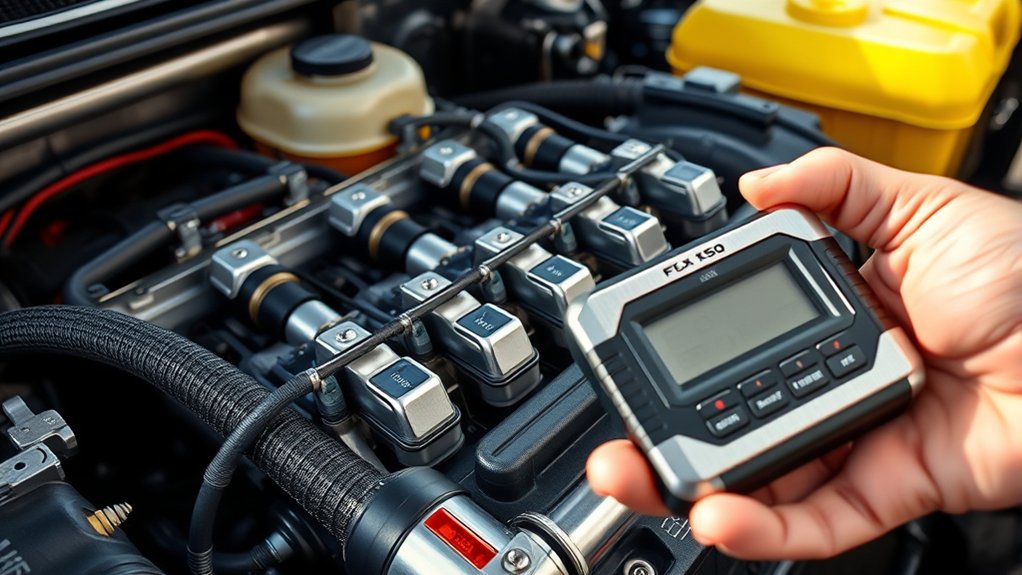
- OBD-II Interface Cable Connects your laptop or handheld tuner to the vehicle’s ECU for data transfer.
- Tuning Software Programs like HP Tuners or SCT allow you to modify fuel maps, ignition timing, and other parameters specific to E85.
- Laptop or Handheld Tuner A reliable device to run the software and upload the tune safely.
With these, you’ll upload your custom calibration accurately, guaranteeing your 5.0 F150 runs at its best on E85 without guesswork or confusion from unrelated technical details.
Monitoring Your 5.0 F150 After an E85 Tune
When should you start monitoring your 5.0 F150 after applying an E85 tune? You should begin immediately, as early data collection is critical for confirming the tune’s effectiveness and ensuring engine safety. Focus on parameters like air-fuel ratio, ignition timing, and fuel trim adjustments.
Avoid distractions from lack of relevance or inappropriate topics that do not directly impact engine performance or fuel system behavior. Use reliable scan tools and data logging software to track these metrics in real time.
Consistent monitoring helps identify subtle changes before they escalate, maintaining optimal performance. Keep your data organized and compare it against baseline readings to detect anomalies quickly.
This disciplined approach ensures your E85 tune functions as intended without introducing unforeseen issues.
Troubleshooting Common E85 Tuning Problems
Why does your 5.0 F150 sometimes hesitate or run lean after an E85 tune? It often results from calibration errors or fuel delivery issues. Before diving into unrelated topics, keep this disclaimer note in mind: troubleshooting requires precise diagnostic steps.
Here are three common problems to check:
- Fuel Pressure & Flow: Insufficient fuel pressure causes lean conditions; verify your pump and regulator.
- Sensor Calibration: Oxygen sensors must correctly interpret the ethanol blend; incorrect sensor data leads to hesitation.
- Tuning Parameters: Improper fuel maps or timing adjustments can cause lean spikes or hesitation under load.
Address these systematically to restore optimal performance. Avoid jumping to unrelated topics like hardware modifications before confirming the tune and sensor accuracy are correct.
Frequently Asked Questions
Can E85 Tuning Improve My Truck’s Fuel Economy?
Yes, e85 tuning optimization can improve your truck’s fuel economy by adjusting fuel maps for ethanol blends, enhancing combustion efficiency. However, actual gains depend on driving conditions and precise calibration tailored to your 5.0 F150’s setup.
Is E85 Tuning Safe for Long-Term Engine Health?
Engine tuning tailored to e85’s fuel compatibility can safeguard your truck’s long-term health. By precisely adjusting timing and fuel maps, you’ll prevent knocking and wear, ensuring your engine runs reliably without risking damage over time.
How Does E85 Tuning Impact My 5.0 F150’s Warranty?
You risk voiding warranty implications because e85 tuning often lacks factory validation. Manufacturers typically don’t approve aftermarket fuel maps, so any engine issues may not be covered, impacting your 5.0 F150’s factory warranty protection.
Are There Specific Brands of E85 Recommended for Tuning?
You’ll want to obsess over brand compatibility. Only fuels with consistent ethanol content above 83% ensure flawless tuning.
Brands like VP Racing and Sunoco dominate because they deliver precise blends that keep your 5.0 F150 running optimally every time.
Can I Switch Back to Regular Gasoline After E85 Tuning?
Yes, you can switch back to regular gasoline after e85 tuning, but frequent switching may cause engine wear due to different fuel properties.
Ensure your tune supports flex-fuel operation to minimize potential mechanical stress and optimize performance.
Conclusion
Tuning your 5.0 F-150 for E85 can boost power by up to 15%, thanks to ethanol’s higher octane rating and cooler combustion. To achieve this, you’ll need ethanol-compatible fuel hardware, precise ECU tuning for a 9.8:1 AFR, and thorough data logging during road tests.
With the right upgrades and calibration, you’ll optimize performance while protecting your engine. Stay attentive to fuel system integrity and manufacturer limits to ensure safe, reliable operation on E85.
In conclusion, knowing what you need to E85 tune a 5.0 F-150 is essential for maximizing power and maintaining engine safety on this higher-octane fuel.