What Is in a Battery Charger
Think of a battery charger like a skilled conductor, orchestrating various components to convert chaotic AC power into a steady, safe DC current. A battery charger plays a crucial role in managing this transformation efficiently.
You might not realize it, but inside, transformers, rectifiers, and regulators work in precise harmony to protect both your battery and the power source. Understanding these elements reveals why chargers aren’t just simple plugs but complex devices designed to ensure efficiency and longevity.
What exactly happens inside?
Key Takeaways
- Chargers convert high-voltage AC from the wall into low-voltage DC suitable for battery charging.
- Transformers step down voltage and provide electrical isolation for safety and interference prevention.
- Rectifiers convert AC to pulsed DC, which is then filtered and regulated to supply clean, steady DC.
- Control circuits monitor voltage, current, and temperature to prevent overcharging and overheating.
- Thermal management components like heat sinks and sensors ensure safe operation by dissipating heat effectively.
How Battery Chargers Convert Power From Wall Outlets
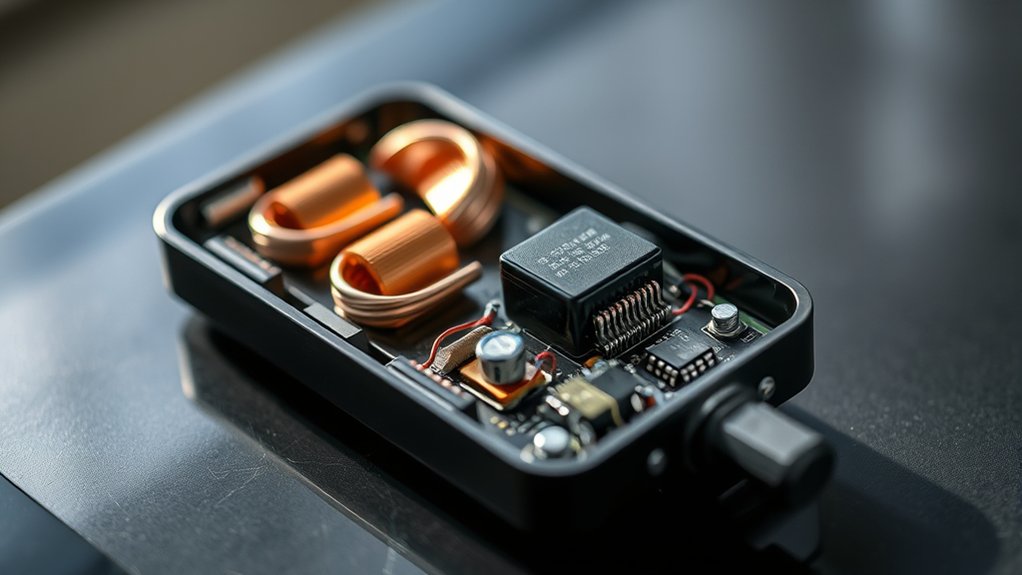
How exactly does a battery charger convert the high-voltage alternating current (AC) from a wall outlet into the low-voltage direct current (DC) required by your battery? The charger first isolates the device from the electrical grid to ensure safety and prevent interference; this grid isolation is essential.
Then, it systematically rectifies AC into DC while regulating voltage and current levels to match your battery’s specifications. This conversion process is optimized to maximize charging efficiency, minimizing energy loss and heat generation.
Advanced control circuits monitor output parameters, adjusting dynamically to maintain stable DC supply. By precisely managing these factors, the charger guarantees safe, efficient power delivery to your battery, prolonging its lifespan and performance without wasting energy in the conversion process.
What Transformers Do Inside Your Battery Charger
Why do transformers play a critical role inside your battery charger? Their primary function is to step down the high voltage from the wall outlet to a safer, lower voltage suitable for your battery.
Transformers function by transferring energy through magnetic induction between coils, ensuring efficient voltage conversion. Additionally, they provide essential isolation benefits by electrically separating the input side from the output, protecting you and your device from potential electrical faults or surges.
Transformers transfer energy via magnetic induction and provide crucial electrical isolation for safety and efficiency.
This isolation enhances safety by preventing direct current flow between circuits while allowing energy transfer. Without transformers, your charger wouldn’t regulate voltage properly or maintain the necessary safety standards.
In essence, transformers ensure that your battery receives the correct voltage safely and reliably, making them indispensable inside every battery charger.
Why Rectifiers Are Essential for Charging Batteries
You can’t charge a battery directly with AC power, so the rectifier converts it into the DC voltage the battery requires. This conversion is critical because batteries rely on steady, regulated voltage to charge safely and efficiently.
Without precise voltage regulation through rectification, the battery could be damaged or fail to charge properly.
AC to DC Conversion
Where does the power that charges your battery actually come from? It starts as alternating current (AC) from the mains supply, which requires AC to DC conversion to be usable for battery charging.
The transformer operation steps down the high voltage AC to a safer, lower voltage. Then, the rectifier converts this AC into direct current (DC), essential because batteries only accept DC.
Here’s a simplified process visualization:
| Step | Function | Output Type |
|---|---|---|
| Transformer | Voltage reduction | Low-voltage AC |
| Rectifier | AC to DC conversion | Pulsed DC |
| Filtering Circuit | Smooths DC waveform | Steady DC |
| Battery Charging | Supplies power to battery | Usable DC |
This precise AC to DC conversion enables efficient, safe battery charging.
Voltage Regulation Importance
Although the rectifier converts AC to DC, the resulting output still contains voltage fluctuations and ripples that can harm the battery or reduce charging efficiency. You need a voltage regulation stage to minimize voltage ripple and maintain output within strict regulation tolerance.
Excessive voltage ripple causes overheating and chemical degradation inside the battery, shortening its lifespan. Without precise regulation, the charger may deliver inconsistent current, impairing the charging cycle.
A well-designed rectifier combined with voltage regulators ensures the DC output remains stable, protecting the battery from transient spikes and drops. By controlling voltage ripple and maintaining regulation tolerance, you optimize energy transfer and prevent damage.
Consequently, rectifiers are essential not just for conversion but for delivering a clean, steady voltage critical for safe, efficient battery charging.
How Voltage Regulators Protect Your Devices
How does a voltage regulator safeguard your electronic devices during charging? It maintains a consistent output voltage, preventing damage from fluctuations. By controlling voltage precisely, it enhances power efficiency, reducing energy waste and heat generation.
Here’s how voltage regulators protect your device:
- Stabilize Output Voltage: Ensure your device receives a steady voltage regardless of input variations.
- Prevent Overvoltage: Avoid voltage spikes that can degrade or destroy electronic components.
- Support Power Efficiency: Optimize energy use by delivering only the required voltage.
- Integrate Status Indicators: Provide real-time feedback on charging conditions, alerting you to anomalies.
What Safety Circuits Do Inside a Battery Charger?
You rely on safety circuits to prevent overcharging, which can damage your battery or reduce its lifespan. These circuits also monitor temperature to avoid overheating during charging.
Additionally, they detect and stop short circuits to protect both the charger and your device.
Overcharge Protection Mechanisms
Why is overcharge protection essential in battery chargers? It prevents damage and potential hazards by stopping excessive current flow once the battery reaches full charge. Overcharge detection circuits continuously monitor voltage and current levels, triggering safety interlocks that cut off charging to maintain battery integrity. These mechanisms guarantee safe, reliable operation.
Key functions include:
- Precisely sensing voltage thresholds to detect full charge conditions.
- Activating safety interlocks to interrupt charging instantly.
- Preventing thermal runaway by halting overcurrent situations.
- Maintaining battery lifespan by avoiding stress from overcharging.
Temperature Monitoring Functions
Where does temperature monitoring fit into the safety architecture of a battery charger? It plays a critical role by continuously analyzing the battery’s thermal state through temperature sensing components embedded within the charger. These sensors detect deviations from optimal operating temperatures, triggering thermal warnings when thresholds are exceeded.
You rely on this function to prevent overheating, which can lead to battery damage or hazardous conditions. The charger’s internal circuitry processes temperature data in real-time, enabling it to adjust charging rates or halt the process altogether if necessary.
This precise monitoring ensures the battery remains within safe thermal limits, enhancing both safety and longevity. Without effective temperature sensing and timely thermal warnings, the charger risks failing to mitigate heat-related issues that compromise performance and user safety.
Short Circuit Prevention
While temperature monitoring guards against thermal risks, short circuit prevention tackles another critical hazard that can cause immediate and severe damage to both the battery and charger.
A short circuit can induce excessive current flow, risking component failure and drastically reducing battery life. To counter this, chargers implement safety circuits that:
- Detect sudden drops in circuit resistance indicative of a short circuit.
- Interrupt charging current instantly to prevent damage.
- Employ resettable fuses or electronic switches for automatic recovery.
- Monitor voltage and current continuously to identify anomalies early.
Heat Management Techniques in Battery Chargers
Although battery chargers are designed to efficiently convert electrical energy, they inevitably generate heat that must be managed to maintain performance and safety. You need to optimize heat dissipation and apply thermal insulation to prevent overheating.
Common techniques include heat sinks, forced air cooling, and thermal interface materials, each balancing efficiency and cost.
| Technique | Purpose | Application Context |
|---|---|---|
| Heat Sink | Passive heat dissipation | Compact chargers |
| Forced Air Cooling | Active heat removal | High-power chargers |
| Thermal Pads | Enhance conduction | Between components |
| Thermal Insulation | Prevent heat spread | Protect sensitive parts |
| PCB Design | Optimize airflow | Overall thermal control |
How Current Control Prevents Battery Damage
You need to regulate the charging current precisely to avoid stressing the battery’s internal chemistry. By controlling the current, you prevent overcharge conditions that can cause capacity loss or permanent damage.
Understanding this mechanism is key to designing chargers that safeguard battery health.
Regulating Charging Current
How does controlling the charging current protect your battery from damage? Precise regulation of current is essential to maintain battery health and optimize charging efficiency.
When you regulate the charging current, you:
- Prevent excessive heat generation, which degrades battery materials.
- Avoid rapid chemical reactions that reduce battery lifespan.
- Ensure stable voltage levels, maintaining cell integrity.
- Maximize charging efficiency by matching current to battery capacity.
Preventing Overcharge Damage
Why does controlling the charging current matter when it comes to preventing overcharge damage? When you manage the current precisely, you avoid pushing excess energy into the battery once it reaches full capacity.
Overcharging accelerates battery aging by causing electrolyte breakdown and internal temperature rise, which degrade the cell’s chemistry. By limiting the current, you reduce stress on the battery during each charging cycle, extending its useful life.
Proper current control also prevents gas buildup and swelling, common effects of overcharge. In effect, controlling current ensures that every charging cycle maintains the battery’s integrity without pushing it beyond its chemical limits.
This careful regulation minimizes capacity loss and preserves performance, ultimately preventing the irreversible damage associated with repeated overcharging.
Types of Battery Chargers and Their Key Components
Which types of battery chargers best suit your needs depends on understanding their core designs and components. Chargers vary based on battery chemistry and charge termination methods, essential for safety and efficiency. Here are four primary types:
- Constant Current Chargers Deliver a steady current until voltage reaches a cutoff, ideal for lead-acid batteries.
- Constant Voltage Chargers Maintain a fixed voltage, allowing current to taper as the battery charges, common for lithium-ion.
- Trickle Chargers Provide low current to maintain full charge without overcharging, suited for standby applications.
- Smart Chargers Integrate microcontrollers to adjust charging profiles based on battery chemistry and state, optimizing charge termination.
Each type incorporates components like transformers, rectifiers, and control circuits to manage voltage, current, and termination, ensuring safe and effective charging tailored to specific battery chemistries.
Key Features That Improve Charger Intelligence and Efficiency
What distinguishes advanced battery chargers from basic models is their ability to intelligently manage charging processes to maximize efficiency and battery lifespan. You’ll find that these chargers comply with stringent charging standards, ensuring compatibility and optimized performance across various battery chemistries.
They incorporate microcontroller-based systems that continuously monitor voltage, current, and temperature, adjusting parameters dynamically to prevent overcharging and overheating. Plug safety features are integral, including insulated connectors and automatic shutoff mechanisms to avoid electrical hazards during connection or disconnection.
Additionally, smart chargers use pulse charging and trickle modes to maintain battery health without wasting energy. By adhering to recognized charging standards and embedding robust safety protocols, these chargers enhance operational reliability and extend battery usability, making your charging process safer and more efficient.
How Charger Components Work Together to Extend Battery Life
Building on the intelligent management features of advanced chargers, the interplay between various components directly influences how effectively a battery’s lifespan is prolonged. You’ll find that understanding these interactions helps optimize charging protocols tailored to specific battery chemistry.
Key factors include:
- Voltage and current regulation: Precisely controls charging parameters to prevent overcharging and thermal stress.
- Battery chemistry monitoring: Adjusts charging profiles dynamically, accommodating the unique needs of lithium-ion, NiMH, or other chemistries.
- Thermal management systems: Prevent overheating, which degrades battery cells prematurely.
- Wireless charging modules: Incorporate feedback loops ensuring efficient energy transfer without inducing excess heat or current spikes.
Frequently Asked Questions
How Do Battery Chargers Differ for Various Battery Chemistries?
You’ll find chargers differ by chemistry because each chemistry demands unique charging protocols. Your charger chemistry must match battery type to regulate voltage, current, and timing precisely, ensuring safe, efficient charging and preventing damage or capacity loss.
What Environmental Factors Affect Battery Charger Performance?
You’ll find environmental factors like temperature, humidity, and altitude directly affect battery performance and charger efficiency.
Extreme heat or cold can reduce charging speed and capacity, while moisture and air pressure impact electrical conductivity and safety.
Can a Charger Cause Batteries to Overheat or Swell?
You might encounter a charger’s “thermal enthusiasm” leading to overheating risks. If it mismanages voltage or current, swelling causes emerge from internal pressure.
Proper charger settings and monitoring reduce these mechanical stresses effectively.
How Does a Charger Communicate Charging Status to Users?
You’ll see charging indicators like LEDs or digital displays that show progress, while safety signals alert you if overheating or faults occur. These communicate real-time status, ensuring you monitor charge levels and maintain safe operation effectively.
What Are Common Signs of a Failing Battery Charger?
Common failure signs include overheating, inconsistent charging, unusual noises, or indicator light malfunctions.
You should follow user safety precautions by unplugging the charger immediately and avoiding use until it’s inspected or replaced to prevent hazards.
Conclusion
You hold a complex orchestra in your hands—transformers stepping down voltage like conductors tuning instruments, rectifiers shaping raw energy into steady DC rhythms, and regulators keeping harmony to protect your devices.
Safety circuits stand as vigilant guardians, while current control fine-tunes the flow, preventing damage. Together, these components compose a precise symphony that not only charges but extends your battery’s life.
This intricate design ensures reliable power for every journey ahead, highlighting the essential role of a battery charger.