How Many Volkswagen Beetles Were Made
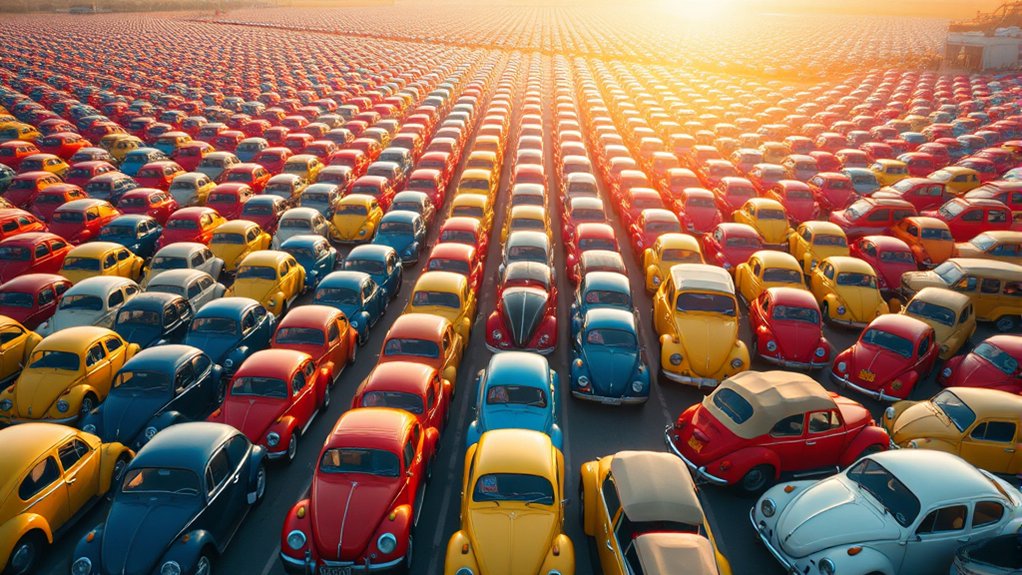
Imagine a sea of classic cars stretching across decades, each Volkswagen Beetle a testament to automotive history.
The number of Volkswagen Beetles made is truly staggering. You might be surprised to learn that around 21 million of these vehicles rolled off production lines worldwide, making it one of the most produced cars ever.
But understanding how this number came to be involves exploring shifts in manufacturing locations, design tweaks, and changing market demands that shaped its enduring legacy.
Each Beetle tells a story of innovation and adaptation.
This iconic car continues to capture the imagination of enthusiasts around the globe.
Key Takeaways
- Over 21 million Volkswagen Beetles were produced worldwide, making it one of the most produced cars in history.
- Production started in 1938 and continued with some interruptions until officially ending in 2003.
- Peak manufacturing occurred in the 1960s, with over 1.5 million units produced annually by mid-decade.
- Major production hubs included Germany, Mexico, Brazil, and South Africa, adapting the Beetle to regional markets.
- Limited edition Beetles were produced in smaller numbers, adding exclusivity but not significantly altering total production figures.
Total Volkswagen Beetle Production Numbers
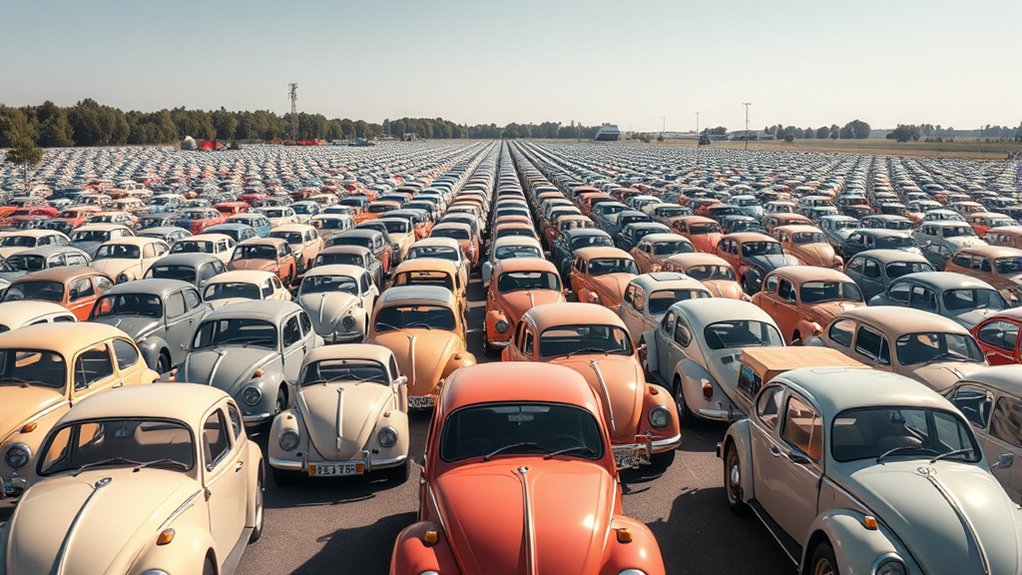
How many Volkswagen Beetles were made in total? Over 21 million units rolled off production lines worldwide, making it one of the most produced cars in history. These production numbers reflect the Beetle’s global popularity and adaptability.
You’ll notice that despite numerous design changes over the decades, such as adjustments to the engine, body shape, and interior features, the core aesthetic remained remarkably consistent. This balance helped maintain a steady demand.
Tracking these production numbers also reveals how different markets influenced Beetle variants, with specific models tailored to regional preferences. Understanding the total production numbers alongside design changes gives you insight into how Volkswagen managed to sustain the Beetle’s appeal for such a long time without losing its iconic identity.
Volkswagen Beetle Production Timeline: Start to End Years
The impressive total production of over 21 million Volkswagen Beetles didn’t happen overnight. It spanned several decades, reflecting shifts in automotive technology, consumer preferences, and global markets. You’ll find that the Beetle’s production timeline starts in 1938 and officially ends in 2003, with some exceptions continuing later in specific regions.
Throughout this period, Volkswagen adapted the model to various markets, introducing numerous regional variants to meet local demands. Additionally, limited edition runs punctuated the timeline, offering collectors unique versions that boosted appeal. Key timeline highlights include:
- Initial production from 1938, with interruptions during World War II
- Post-war mass production ramping up in the 1950s and 1960s
- Final assembly ceasing in 2003 in Mexico, but limited editions extended briefly afterward
Understanding this helps you grasp the Beetle’s enduring legacy.
Volkswagen Beetle Production Numbers by Decade
You’ll see that Volkswagen Beetle production started modestly in the 1940s, with limited output due to wartime constraints.
In the 1950s, production ramped up markedly as demand increased worldwide. By the 1960s, manufacturing reached its peak, making the Beetle one of the best-selling cars globally.
1940s Beetle Output
When did Volkswagen Beetle production truly begin to take shape in the 1940s? The decade marked a complex period for the Beetle, as World War II shifted priorities away from civilian car manufacturing. Despite this, the Beetle’s distinctive aesthetics remained unchanged, preserving its iconic design.
Production logistics were heavily impacted by wartime constraints, limiting output significantly.
Here’s what defined 1940s Beetle production:
- Limited civilian production due to military focus
- Use of existing designs, maintaining Beetle aesthetics
- Production concentrated in fewer facilities with resource constraints
You’ll find that while total numbers were modest, the groundwork for post-war scaling was laid, preserving the Beetle’s identity and manufacturing processes despite turbulent conditions.
1950s Production Growth
How did Volkswagen manage to transform limited wartime production into a booming manufacturing success during the 1950s? You’ll find that key production metrics reveal a sharp increase—from roughly 10,000 units in 1949 to over 200,000 by the decade’s end.
This growth wasn’t accidental. Volkswagen optimized assembly lines and expanded factory capacity, allowing steady monthly output increases. Simultaneously, the Beetle underwent subtle design evolution. Improvements in engine reliability, interior comfort, and exterior aerodynamics enhanced appeal without sacrificing the original concept’s simplicity.
These refinements, coupled with rising consumer demand and export expansion, directly influenced production volume. By analyzing the 1950s data, you see how Volkswagen’s strategic enhancements in both manufacturing efficiency and product design laid a crucial foundation for the Beetle’s enduring success.
1960s Peak Manufacturing
Why did the 1960s mark the peak of Volkswagen Beetle production? During this decade, the Beetle became a global icon, reflecting post-war economic growth and expanding consumer demand. You’ll find that production numbers soared, surpassing 1.5 million units annually by the mid-60s, a record unmatched in subsequent decades.
Key factors include:
Mass production optimization: Volkswagen refined assembly processes, boosting output efficiently.
Global market expansion: New plants outside Germany, especially in the U.S. and Mexico, increased capacity.
Cultural popularity: The Beetle’s unique design appealed worldwide, fueling sales.
Avoiding unrelated topics or off topic discussion ensures you focus on how these elements contributed directly to peak manufacturing, rather than veering into tangential subjects about the car’s later decline or unrelated automotive trends.
Countries That Manufactured the Volkswagen Beetle
You’ll find that Volkswagen Beetles were manufactured in several countries, with Germany, Mexico, and Brazil leading production. Each location introduced unique regional variations to adapt to local markets and regulations.
Understanding these differences helps explain the Beetle’s global appeal and longevity.
Major Production Countries
Where did the iconic Volkswagen Beetle roll off the assembly lines? Understanding the major production countries helps dispel many production myths and collector myths surrounding the Beetle’s origin.
You’ll find that the Beetle wasn’t confined to one factory or even one continent. Key countries that significantly contributed to its mass production include:
- Germany: The birthplace of the Beetle, where production began in the late 1930s and continued for decades.
- Mexico: Hosted one of the largest Beetle factories, producing vehicles well into the 2000s, making it a major contributor to the Beetle’s longevity.
- Brazil: Produced Beetles tailored for local markets, maintaining production until the early 1990s.
These nations shaped the Beetle’s global footprint and helped achieve its staggering production numbers.
Unique Regional Variations
The Volkswagen Beetle’s production spanned multiple countries, each adding its own unique touch to the model. When you examine regional quirks, you notice how Mexico, Brazil, and South Africa adapted the Beetle to local conditions.
For instance, Mexico’s versions featured reinforced suspensions to handle rougher roads, while Brazil’s models often included unique interior trims catering to local tastes. These regional quirks weren’t just cosmetic; they aligned with specific export markets to boost appeal and durability.
You’ll also find that South African Beetles incorporated components suited for hotter climates, enhancing performance. Understanding these variations helps you appreciate how Volkswagen tailored the Beetle globally, ensuring it remained relevant and functional across diverse environments and consumer needs.
How Design Changes Influenced Beetle Production
How did design changes impact the production numbers of the Volkswagen Beetle? You’ll find that modifications in design aesthetics and engineering directly influenced its mass appeal and manufacturing scale. The Beetle’s distinctive air cooled engineering allowed for a simpler, more durable engine, reducing production complexity and maintenance costs, which attracted global consumers.
Key factors include:
- Streamlined body shape that enhanced both aerodynamics and visual appeal, boosting demand.
- Incremental updates to interior comfort and exterior styling that kept the model contemporary without sacrificing its iconic look.
- Engineering reliability from the air cooled engine minimized recalls and production halts, sustaining high output levels.
These design evolutions ensured the Beetle remained relevant, driving consistent production growth over decades.
Top-Selling Volkswagen Beetle Models Worldwide
Among Volkswagen Beetle models, certain versions have stood out as top sellers due to their unique features and market timing. You’ll find the original Type 1, the New Beetle (1997-2011), and the Beetle A5 (2011-2019) leading global sales. These models combined innovation with nostalgia, appealing to diverse buyers.
Here’s a concise overview:
| Model | Units Sold (approx.) |
|---|---|
| Type 1 | 21 million |
| New Beetle | 1.3 million |
| Beetle A5 | 350,000 |
Avoid unrelated topic or irrelevant discussion like engine specs here; focus strictly on sales figures and market impact. This sharp focus clarifies which Beetle versions truly dominated worldwide production and consumer preference.
Impact of Limited Edition Beetles on Production
When you examine limited edition Volkswagen Beetles, you notice their unique design elements often set them apart from standard models. These special editions typically have lower production volumes, which directly impact the overall Beetle production numbers.
You’ll also see that collector demand for these rare models influences Volkswagen’s strategy in releasing them.
Unique Design Elements
What sets limited edition Volkswagen Beetles apart from their standard counterparts? You’ll notice distinct design aesthetics and exclusive color palettes that make each variant unique. These limited editions often showcase:
- Customized interior materials and finishes enhancing tactile and visual appeal.
- Rare exterior paint colors, sometimes metallic or matte, unavailable in regular models.
- Special badging or decals that emphasize exclusivity and heritage.
These elements don’t just boost visual allure; they reflect Volkswagen’s strategic effort to appeal to collectors and enthusiasts. By introducing unique design aesthetics and curated color palettes, Volkswagen creates a differentiated product line that stands out without altering core mechanical components.
Understanding these details helps you appreciate how limited editions impact brand perception and desirability, setting them apart in both production and market appeal.
Production Volume Effects
Limited edition Volkswagen Beetles directly influence overall production volumes by introducing targeted runs that deviate from mass production norms. When you examine these editions, you’ll notice how specific design tweaks, such as unique paint schemes or interior details, set them apart.
These changes often require adjustments in manufacturing processes, especially since Beetles maintain their classic rear engine placement, which complicates modifications. Because limited editions are produced in smaller quantities, they don’t substantially alter total production figures but can cause temporary shifts in assembly line focus.
You’ll find that these runs test new design elements or commemorate milestones, which means production schedules adapt to accommodate them without disrupting the steady output of standard models. This balance helps Volkswagen manage volume while diversifying its Beetle offerings.
Collector Demand Influence
How do collector preferences shape Volkswagen Beetle production? Limited edition Beetles respond directly to collector trends, influencing both design and manufacturing choices. When demand for rare models rises, Volkswagen increases production of distinctive variants, impacting overall output. This creates noticeable price fluctuations in the collector market.
You’ll see these effects in:
- Limited runs with unique features, boosting appeal and scarcity
- Strategic releases timed to heighten exclusivity and value
- Market-driven adjustments based on collector feedback and demand data
Comparing Volkswagen Beetle Production to Other Classic Cars
When you compare the production numbers of the Volkswagen Beetle to other classic cars, its scale stands out remarkably. Over 21 million units were produced, far surpassing iconic models like the Ford Mustang, which sold around 10 million, and the Chevrolet Corvette, with roughly 1.5 million units.
This vast difference dispels the absurd rumor that Beetle production was exaggerated through marketing gimmicks. Instead, the Beetle’s production longevity and global appeal drove its unmatched numbers. Unlike limited-edition classics, the Beetle’s continuous manufacturing from 1938 to 2003 ensured steady output.
Why Beetle Production Ended and Its Legacy
Why did Volkswagen decide to end Beetle production after more than six decades? The decision was driven by evolving market demands and stricter environmental regulations, making the classic Beetle less viable. While some might see discussions about electric vehicle trends as an irrelevant tangent, it’s vital to recognize how these shifts influenced the Beetle’s phase-out.
You should understand these key reasons:
- Rising production costs due to outdated design
- Consumer preference shifting toward modern, efficient vehicles
- Regulatory pressures on emissions and safety standards
Despite ending production, the Beetle’s legacy remains significant. Unlike an unrelated contrast such as unrelated car models fading quickly, the Beetle’s enduring influence is felt in automotive design and cultural history, highlighting its unique role beyond mere numbers.
Why the Volkswagen Beetle Became a Global Cultural Icon
What made the Volkswagen Beetle stand out beyond its function as a simple car? Its unique design combined affordability with charm, making it accessible worldwide. You’ll notice that the Beetle interior was minimalistic yet practical, reflecting thoughtful engineering rather than luxury.
This simplicity allowed owners to personalize their cars, fostering a deep emotional connection. Vintage photography captures this cultural phenomenon, showcasing Beetles in diverse settings, from urban streets to countercultural gatherings, cementing its iconic status.
The Beetle’s distinctive shape and reliability made it a symbol of freedom and individuality during the 20th century. As you explore its history, you see how the Beetle transcended transportation, becoming a global cultural icon through design, adaptability, and symbolic meaning embedded in both its physical form and social presence.
Frequently Asked Questions
What Are Common Maintenance Issues With Volkswagen Beetles?
You’ll face common maintenance issues like electrical problems, rust, and engine leaks. Luckily, parts availability is good, keeping maintenance costs reasonable.
Regular inspections and timely repairs will help you avoid costly damages and keep your Beetle running smoothly.
How Fuel-Efficient Is the Volkswagen Beetle Compared to Modern Cars?
Imagine you drive a classic Beetle averaging 29 mpg; compared to modern cars boasting 35-50 mpg thanks to fuel economy comparisons and modern innovations like turbocharging and hybrid systems, you’ll notice the Beetle’s efficiency lags behind considerably.
What Is the Average Resale Value of a Volkswagen Beetle?
You’ll find the average resale value of a Volkswagen Beetle ranges widely, typically between $5,000 and $15,000, depending on model year and condition.
Common maintenance affects value, so well-maintained cars usually fetch higher prices.
Are Volkswagen Beetles Suitable for Off-Road Driving?
You won’t find a Volkswagen Beetle excelling off road durability as is; it’s like a city bird in a forest. But with suspension upgrades, you can boost its ruggedness and tackle rougher terrains more confidently and safely.
What Aftermarket Modifications Are Popular for Volkswagen Beetles?
You’ll find popular aftermarket modifications for Volkswagen Beetles include engine swaps for improved performance and aftermarket aerodynamics to enhance stability and style.
These upgrades substantially boost your Beetle’s power and handling characteristics.
Conclusion
You might think the Volkswagen Beetle’s production numbers are just impressive—but they’re nothing short of automotive legend. With around 21 million units crafted across decades and continents, this car didn’t just roll off assembly lines; it rolled through history itself.
Its enduring design tweaks and cultural impact made it more than a car—it became a global icon. Understanding its vast production journey reveals why the Volkswagen Beetle remains unmatched in automotive folklore.