How to Make a Battery Charger
If you want to build a reliable battery charger, you’ll need to understand how to select the right power source, match voltage levels, and incorporate current limiting to protect your battery. Designing an effective battery charger requires careful consideration of these factors to ensure optimal performance.
It’s important to take into account the battery type and implement safety features like temperature sensing and automatic cutoffs. These elements guarantee efficiency and longevity, but how you combine them into a functional design can make all the difference in performance and safety.
Key Takeaways
- Select a power source matching the charger’s voltage and current specifications for safe and efficient operation.
- Use a transformer, rectifier, filter capacitor, and voltage regulator to build a stable charging circuit.
- Connect charger positive to battery positive and negative to negative using insulated clamps or connectors.
- Monitor output voltage and current with a multimeter and ammeter to ensure proper charging parameters.
- Incorporate safety features like temperature sensors and automatic cutoffs to prevent overheating and overcharging.
Battery Charger Basics Explained
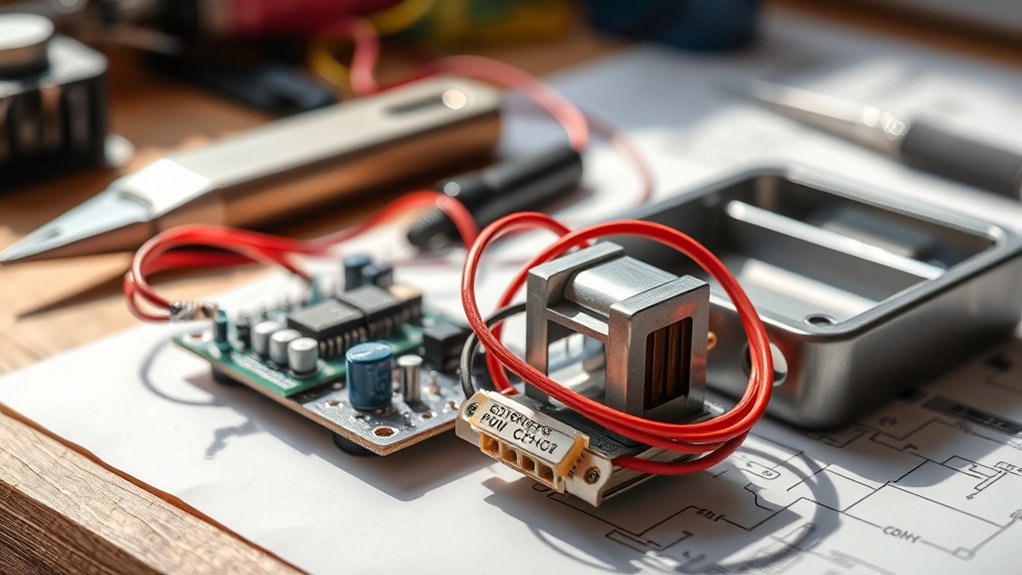
How exactly does a battery charger work to restore power efficiently? It regulates voltage and current, delivering controlled energy to recharge the battery without causing damage. You need to understand the charger’s ability to provide a stable output while preventing overcharging, which is essential for battery safety.
Modern chargers integrate circuitry that monitors temperature and voltage to avoid overheating or excessive current flow. When designing for portable charging, you must guarantee the charger is compact yet capable of maintaining precise control over the charge cycle. This precision prevents degradation of battery cells and extends lifespan.
Picking the Best Power Source for Your Charger
You need to select a power source that matches your charger’s voltage and current specifications precisely. Consider the types of power sources available, such as AC adapters, batteries, or solar cells, and evaluate their efficiency and safety profiles.
Making the right choice ensures optimal performance and protects both your charger and the battery.
Types Of Power Sources
Although selecting a power source may seem straightforward, choosing the right one for your battery charger considerably impacts its efficiency, safety, and compatibility. You’ll encounter options like AC mains, DC adapters, solar panels, and rechargeable batteries.
Each has distinct electrical characteristics such as voltage stability, current capacity, and environmental footprint. Applying green chemistry principles, solar power stands out for sustainability, minimizing ecological harm.
However, a detailed cost analysis often reveals trade-offs: solar setups can have higher upfront costs but lower operational expenses. Conversely, AC mains provide consistent power with low initial investment but lack portability.
Assess your application’s demands carefully; consider availability, reliability, and environmental impact before deciding. Balancing these factors ensures optimum performance and adherence to green chemistry ideals without compromising budget or safety.
Voltage And Current Requirements
When selecting a power source for your charger, understanding the voltage and current requirements is essential to guarantee safe and efficient operation. You need to match the output voltage closely with the battery’s nominal voltage to prevent overvoltage damage. Current capacity must meet or exceed the battery’s charging current without causing excessive heat.
Mastering volt/amp basics helps you pick a power source that balances performance and charging safety.
| Battery Type | Nominal Voltage (V) |
|---|---|
| NiMH | 1.2 |
| Li-ion | 3.6 – 3.7 |
| Lead Acid | 2.0 |
| LiPo | 3.7 |
| NiCd | 1.2 |
Accurate voltage and current selection protects battery health and ensures reliable charger function.
Efficiency And Safety Considerations
How do you guarantee your battery charger operates efficiently while maintaining safety? Selecting the optimal power source is critical for balancing efficiency and safety considerations. You must analyze voltage stability, current capacity, and protective features to avoid damage or hazards.
Focus on these key efficiency tips and safety considerations:
- Use a regulated power supply to maintain consistent voltage and prevent overcharging.
- Incorporate current limiting circuits to avoid excessive current flow and thermal issues.
- Choose components rated for the maximum expected load to ensure durability and prevent failures.
Understanding Different Battery Types to Charge
Why do different batteries require distinct charging methods? Each battery chemistry, such as lead-acid, nickel-cadmium (NiCd), nickel-metal hydride (NiMH), and lithium-ion (Li-ion), has unique voltage thresholds, charge rates, and termination criteria. Charging a Li-ion cell using a lead-acid approach risks damage and safety hazards.
When working on hobbyist projects, understanding these differences is critical, especially under budget constraints that limit access to advanced charging ICs. You must tailor your charger’s voltage and current parameters to the battery type to optimize lifespan and performance.
For example, NiCd batteries tolerate faster charging with periodic discharges, whereas lead-acid batteries require controlled bulk, absorption, and float stages. Recognizing these technical distinctions ensures your DIY charger functions reliably and safely, preventing overcharge, undercharge, or thermal runaway.
Materials Needed to Build Your Battery Charger
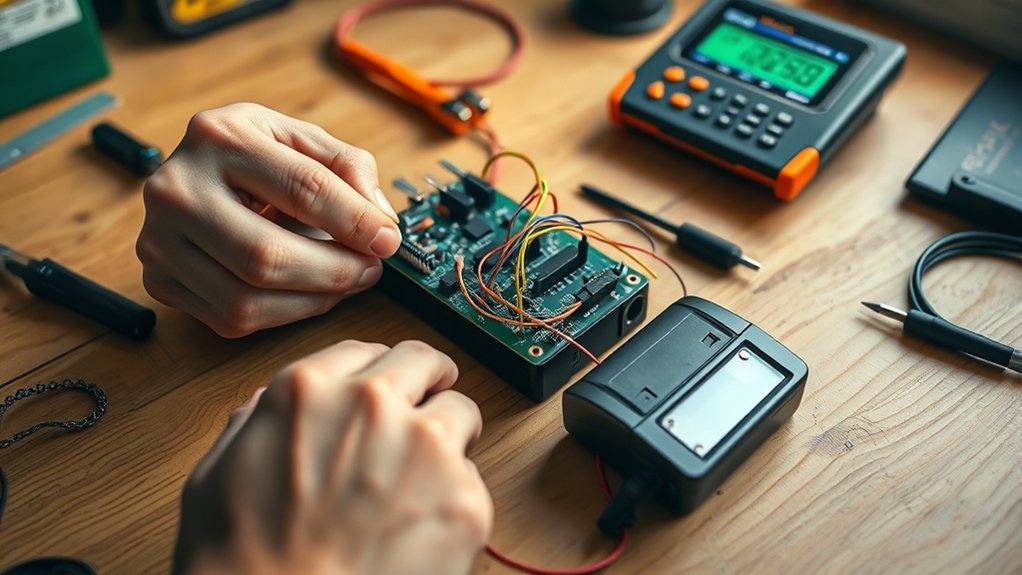
You’ll need to gather essential components like resistors, diodes, and a transformer to build your charger’s circuit. Make sure you have the right tools, including a soldering iron, multimeter, and wire cutters, to assemble everything accurately.
Don’t forget safety equipment such as gloves and goggles to protect yourself during construction and testing.
Essential Components Overview
Building a reliable battery charger requires selecting the right components that ensure safety, efficiency, and functionality. When choosing materials, you must balance cost vs. value, avoiding unnecessary complexity or expense. Using non technical jargon, it’s important to understand each part’s role clearly.
Key components include:
- Transformer or Power Supply: Converts voltage to a suitable level for charging, ensuring stable current flow.
- Rectifier and Filter: Changes AC to DC voltage and smooths it for consistent output.
- Charge Controller: Regulates charging current and voltage to prevent battery damage and overcharging.
Selecting these components carefully helps you optimize performance and longevity while managing costs. Prioritize components with proven reliability to build a charger that operates safely and effectively.
Tools Required For Assembly
Which tools do you need to assemble a reliable battery charger? Focus on precision instruments: a soldering iron with adjustable temperature ensures secure component connections; a digital multimeter allows accurate voltage and continuity testing; and wire strippers help prepare leads without damaging conductors.
Avoid nonessential brainstorming about exotic tools or unrelated considerations like decorative elements. They detract from efficiency. A small Phillips screwdriver set is essential for mounting components, while tweezers facilitate handling small parts.
Additionally, a breadboard or PCB holder can stabilize your workpiece for precise assembly. These tools directly impact the charger’s performance and assembly quality, so prioritize functionality over superfluous equipment.
Safety Equipment Checklist
How can you guarantee safe handling during the construction of your battery charger? Prioritize the use of appropriate safety gear to mitigate risks associated with electrical hazards. You must equip yourself to prevent injury from accidental shorts, sparks, or electric shocks.
Ensure you have the following safety equipment:
- Insulated gloves to protect against electrical currents and prevent direct contact with live wires.
- Safety goggles to shield your eyes from sparks or debris during soldering and assembly.
- A non-conductive work mat to provide an insulated surface, reducing the risk of accidental grounding or short circuits.
Using this safety equipment checklist will help you maintain a controlled, hazard-free workspace while building your battery charger. Always inspect gear before use to ensure integrity against electrical hazards.
Assembling Your Battery Charger Step by Step
A clear workspace and all necessary components ready are essential before you begin assembling your battery charger. Start by securely mounting the transformer and rectifier on a non-conductive surface.
Connect the transformer’s secondary winding to the rectifier input, ensuring polarity accuracy to avoid bad design issues that could impair functionality. Next, wire the filtering capacitor parallel to the rectifier output to stabilize voltage.
Attach the voltage regulator circuit, verifying all connections against the schematic to prevent faults. Use insulated connectors to reduce risk of short circuits. Avoid configurations that enable illegal use, such as charging incompatible battery types or bypassing safety controls.
Throughout assembly, double-check component ratings and wiring directions, as precision here determines charger reliability and safety. This methodical approach minimizes errors and ensures your charger performs as intended.
Safely Connecting Batteries for Charging
When connecting batteries for charging, where you place each terminal and how you secure connections directly impact safety and charger performance. Proper arrangement enhances battery ergonomics, ensuring ease of handling and reducing risk of accidental short circuits.
To maximize charging autonomy and prevent energy loss, follow these guidelines:
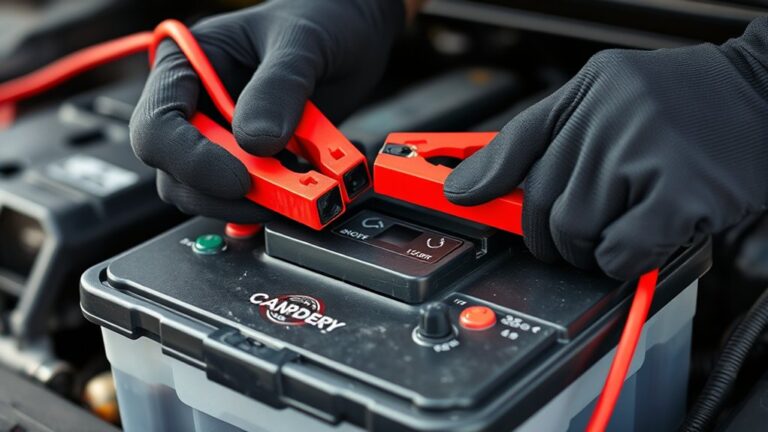
- Connect the positive terminal of the charger to the battery’s positive terminal, and the negative to negative, avoiding reversed polarity.
- Use insulated clamps or connectors to prevent accidental contact and ensure firm, stable connections.
- Arrange batteries to minimize cable length, reducing resistance and heat generation, which impacts charging efficiency.
Adhering to these precise connection protocols optimizes safety, maintains charger integrity, and supports consistent charging autonomy throughout the process.
Testing Your DIY Battery Charger at Home
Before powering up your DIY battery charger, ensure you follow strict safety precautions to prevent electrical hazards and damage. You’ll need to accurately measure voltage, current, and charging time to evaluate performance against your design specifications.
These steps confirm your charger operates reliably and safely under real-world conditions.
Safety Precautions Overview
How can you guarantee safe operation while testing your DIY battery charger at home? Prioritizing concerned safety and legal compliance is essential to prevent hazards and ensure your setup meets regulatory standards.
Begin by assessing your workspace for proper ventilation and secure wiring. Use insulated tools and wear protective gear to mitigate electrical risks. Follow these key precautions:
- Verify all components adhere to safety ratings and legal requirements.
- Double-check polarity connections to avoid short circuits or damage.
- Never leave the charger unattended during initial power-up tests.
Measuring Charger Performance
Why measure your DIY battery charger’s performance accurately? Precise measurement ensures your charger delivers the correct voltage and current, essential for safely charging batteries in applications like an electric car or a solar microgrid.
Begin by using a multimeter to verify output voltage under load conditions, matching your battery’s specifications. Next, employ a clamp ammeter to monitor current flow, confirming it stays within safe operational limits to prevent overheating or damage.
Record charging time and calculate efficiency by comparing input power to output energy stored. Testing under realistic load simulates real-world use, revealing any voltage drops or fluctuations.
Fixing Common Battery Charging Issues
When your battery charger fails to deliver the expected performance, you need to systematically diagnose common issues such as faulty connections, incorrect voltage settings, or damaged components. Start by checking the physical integrity of all wiring and terminals, ensuring no corrosion or loose contacts compromise current flow.
Next, verify the voltage output with a multimeter to confirm it matches your battery’s requirements. Incorrect voltage can result from improper adjustments or internal faults.
Lastly, inspect internal components like resistors and capacitors for signs of damage or wear that may affect efficiency. While discussing aesthetics and budgeting considerations during the initial design phase, keep in mind that shortcuts here can lead to these common failures.
Troubleshoot using these steps:
- Inspect physical connections and terminals
- Measure and confirm voltage output
- Examine internal electronic components for damage
Tips to Make Your Charger Safer and More Efficient
Addressing common charging issues lays the groundwork for enhancing both safety and efficiency in your battery charger design. First, debunk safety myths that often lead to improper handling, such as the belief that all batteries can tolerate constant high current or that ventilation alone prevents overheating.
Integrate precise current and voltage regulation circuits to avoid overcharging, which is the primary trigger for thermal runaway, a dangerous, uncontrolled increase in temperature causing battery failure or fire. Incorporate temperature sensors and automatic cutoff mechanisms to monitor and halt charging if abnormal heat is detected.
Additionally, use quality components with adequate heat dissipation properties to maintain stable operation. By systematically addressing these factors, you’ll improve charger reliability and protect both the battery and user from potential hazards.
Knowing When to Upgrade or Buy a Professional Battery Charger
How can you determine if your current battery charger meets your needs or if it’s time to upgrade or invest in a professional model? Assess your charger’s performance against these critical factors to pinpoint the right upgrade timing.
First, evaluate if your charger handles the battery types and capacities you regularly use. Second, consider if charging speed and efficiency align with your operational demands. Third, analyze safety features. Professional alternatives often offer advanced protections against overcharging and thermal events.
- Compatibility with diverse battery chemistries and sizes
- Charging speed, efficiency, and energy consumption
- Enhanced safety protocols and diagnostic capabilities
Frequently Asked Questions
Can I Use This Charger for Electric Vehicle Batteries?
You can’t safely use this charger for electric vehicle batteries due to charger safety concerns and voltage differences.
DIY electrical risks are high; EV batteries require specialized chargers designed to manage high capacity and complex battery management systems.
How Do I Recycle Old Batteries Safely?
Better safe than sorry: you should follow proper safe disposal methods by taking old batteries to certified recycling centers.
This debunks recycling myths that suggest tossing them in regular trash can cause environmental harm and safety risks.
What Environmental Impact Do Homemade Chargers Have?
You’ll reduce environmental emissions by avoiding mass production, but material sourcing for homemade chargers can still cause ecological strain. Ensure you select sustainable components and properly manage waste to minimize overall environmental impact during assembly and use.
Can This Charger Be Powered by Solar Panels?
Yes, you can power this charger with solar panels, but ensure solar power feasibility by matching voltage and current specs. Prioritize safety considerations like proper regulation, overcharge protection, and insulated wiring to prevent damage or hazards.
Are There Legal Restrictions on Building Battery Chargers at Home?
Imagine John, who faced fines for ignoring safety standards when building chargers. You must guarantee legal compliance, meet safety standards, consider environmental factors, and address liability concerns to avoid risks and operate responsibly within your jurisdiction.
Conclusion
Think of building your battery charger like tuning a high-performance engine—every component must align perfectly for peak efficiency. Just as a well-tuned engine boosts longevity and power, a properly designed charger maximizes battery life and safety.
By carefully selecting parts, following precise assembly steps, and rigorously testing your charger, you guarantee reliable performance. Attention to detail isn’t just technical diligence—it’s the key to freeing your battery’s full potential.
In conclusion, taking the time to build a quality battery charger ensures that your device operates safely and efficiently, ultimately extending the life of your batteries.